


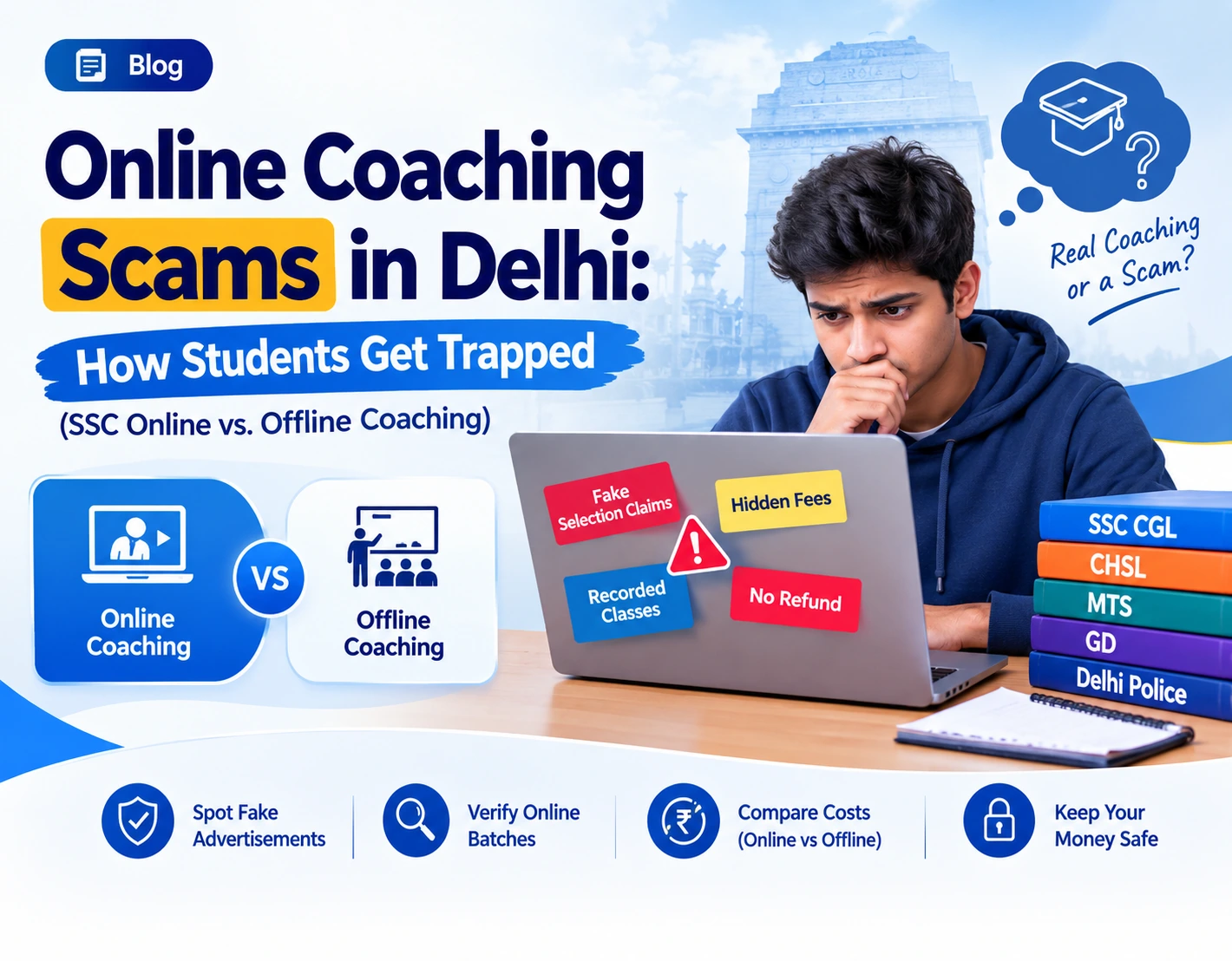
Online Coaching Scams in Delhi: How Students Get Trapped (SSC Online vs. Offline Coaching)
Students don't always have to fall prey to a fake website to lose money in the process of SSC coaching. Problems may occur with a course that is advertised as live but has a major chunk of recorded sessions, with selection claims that lack critical information, and/or with a refund claim that is disputed after the service is not provided.
For students preparing for various SSC examinations (i.e. CGL, CHSL, MTS, GD & Delhi Police), deciding which coaching to take is both an academic and a financial decision. Sometimes families take money from their limited savings. Students from Uttar Pradesh and Bihar, and other states, come to Delhi to take coaching.
Internet and technology have allowed students to prepare for various SSC examinations without moving from their homes. In fact, students don't even have to go to coaching centers and/or meet faculty members in order to take a coaching course. This has its advantages, but the cost of convenience raises an important question: How can students examine a service before they pay for it?
The purpose of this article is to identify documented consumer protection concerns, common warning signs, and provide students with checks they can perform prior to purchasing a service. This article does not accuse any coaching institute of fraud.
1. The Ground Reality: Delhi's SSC Coaching Market
Where students come from
Delhi's coaching areas such as Mukherjee Nagar attract competitive examination aspirants due to the concentration of coaching institutes, teachers, libraries, and student accommodation.
When a student moves from a smaller town, the cost of coaching becomes just one of the many expenses that the family has to bear. Other expenses include food, rent, transportation, coaching material, test series, and other day-to-day expenses.
Some students feel the need to purchase coaching material that improves their competitive exam preparation, as their classmates have better mock test scores and/ or improve their ranking.
With the current state of the SSC coaching, students are reasonably assured of getting structured coaching and regular practice. Students do face challenges when the promised coaching and support do not materialize.
What online coaching solves
Online coaching solves the problem of students having to relocate and shift base to a different city for coaching. Students can do coaching from home and can also get recorded video lessons. Coaching can also be flexible to suit student's time constraints and other commitments.
A student has no way of knowing who will be the instructor, how many classes will be conducted, and how support for doubts will be provided. Students often have to take a leap of faith with online coaching.
There are different kinds of transparency when it comes to coaching. Prospective students have the opportunity to visit centers, assess facilities and check out actual batches. However, a physical presence does not equate to fair and transparent pricing, or accurate advertising.
So the problem isn't with online coaching per se. The problem is with a student's ability to verify a coaching service's claims.
The Central Consumer Protection Authority (CCPA), on 13 November 2024, issued a notice to 45 coaching centers and imposed penalties of ₹54.6 lakh on 18 centers.
In a subsequent notification on 17 December 2024, the government said it had ordered penalties of ₹61.6 lakh on 19 coaching institutes. The penalties and notices were for practices across India. There is no evidence to show that the online coaching institutes providing preparation for the SSC examination are committing fraud.
The guidelines address misleading success claims, concealment of important course information and other practices that can distort a student's purchasing decision.
Source: Government of India: CCPA coaching-sector guidelines and enforcement.
2. Misrepresentations Students Encounter While Purchasing Online Coaching
A. Selection Claims and Topper Testimonials
Coaching advertisements featuring successful candidates or toppers can also include examination ranks and/or large selection counts. While such information may be meaningful, it will only be so if the accompanying claims are correct and provided in the right context.
Just because a candidate is shown on a selection advertisement, it doesn't mean that the candidate studied at that coaching, or that the coaching was involved in the candidate's selection.
To corroborate a success claim, you should ascertain the:
- Examination and year for which the result is claimed
- Name of the course for which the candidate studied with the institution
- Whether the candidate was coached for free or for a fee
- Duration for which the candidate was coached
- If the coaching institute helped the candidate prepare for the exam
The CCPA coaching-advertising guidelines also cover successful candidates, the courses undertaken by them, and whether the courses were free or paid. The guidelines cover other areas to do with misleading advertisements for results.
It cannot be generally said that coaching platforms purchase ranks or pay toppers to fabricate results. A promotional endorsement does not, of itself, mean that the coaching platform is involved in any illegal or unethical activity.
Always request evidence to support the result claimed, and compare it with the information available to you. Consider unsubstantiated selection counts to be unverified, and not as proof of teaching quality.
B. When a live batch contains recorded lectures
Recorded classes are a normal part of online education. They allow students to revise difficult topics and study at a convenient time.
The concern arises when a provider advertises live instruction but delivers recorded content without clearly disclosing the arrangement.
For example, an aspirant may expect a teacher to explain questions during a scheduled session but discover that the course consists mainly of previously recorded lectures. If live doubt resolution was included in the advertised package, the student should check whether that service is actually provided.
The age of a recording alone does not establish that it is unsuitable. Concepts such as percentages, ratios and time and work remain relevant across examination cycles. However, students should verify that examination notifications, syllabus information, practice tests and other time-sensitive material are current.
Before enrolment, ask the provider to confirm:
- Which classes are live and which are recorded.
- Whether the advertised faculty will teach the batch.
- When the course material was last updated.
- Whether live doubt sessions are included.
- How students can ask questions and receive answers.
A disabled YouTube comment section is not proof of a scam. The provider may have legitimate moderation reasons. The more useful question is whether students can independently assess the teaching and obtain academic support.
C. Refund disputes and inaccessible support
Refund disputes can arise when a course is cancelled, advertised services are not delivered or the student requests cancellation under the provider's terms.
The Department of Consumer Affairs reported that the National Consumer Helpline facilitated refunds totalling ₹1.15 crore for coaching students and other affected aspirants between 1 September 2023 and 31 August 2024, following intervention in consumer grievances.
This establishes that refund grievances have been a real consumer-protection concern. It does not establish that every rejected refund is unlawful or that coaching companies routinely block students after payment.
Students should check the following before enrolling:
- The written cancellation and refund policy.
- The conditions under which a refund may be requested.
- Any stated deductions and deadlines.
- The provider's official grievance contact.
- The identity of the business issuing the invoice.
If a provider stops responding after receiving payment, preserve the conversation and send a written complaint through its official contact channel. If the service differs materially from what was advertised, describe the specific discrepancy rather than making unsupported accusations.
Source: National Consumer Helpline.
3. SSC Online vs. Offline Coaching: A Practical Comparison
| Factor | Online coaching | Offline coaching |
|---|---|---|
| Course fees and additional expenses | Usually avoids Delhi relocation costs. Check whether tests, printed notes, doubt sessions and extensions cost extra. | May involve tuition, travel, accommodation, food and study materials. Obtain the complete fee breakdown. |
| Accountability | Depends on class schedules, attendance records, assignment reviews and access to faculty. | Classroom attendance and face-to-face interaction are easier to observe, but individual attention is not guaranteed. |
| Doubt resolution | Can work well when faculty-led sessions and clear response times are provided. | Questions can be asked in person, but crowded batches may limit access to teachers. |
| Faculty verification | Check demonstration lessons, faculty profiles and who will teach the actual batch. | Visit the centre and ask whether you can observe a class or speak with current students. |
| Course updates | Confirm the status of recordings, syllabus information and current mock tests. | Confirm that classroom notes and practice material reflect the relevant examination cycle. |
| Consumer risk | The student may pay before seeing the complete service. Verify the seller, terms and support arrangements. | A physical centre permits an in-person visit, but does not eliminate misleading claims or refund disputes. |
| Suitability | Useful for students who can study independently and have reliable internet access. | Useful for students who benefit from a fixed routine, classroom interaction and peer competition. |
Compare the total cost, not just the advertised fee
For offline coaching, include tuition, rent, food, transport, study materials and test series where applicable.
For online coaching, include the course fee, internet access, materials and any additional charges for tests or academic support.
There is no single cost figure that applies to every Delhi coaching institute. Fees vary by provider, course duration, batch size and services included.
An inexpensive course may offer good value if it provides the promised teaching and support. A more expensive course may be worthwhile if it offers features the student actually needs. Neither price alone establishes quality.
4. Red Flags to Check Before Paying
Use these warning signs to decide which claims require further verification.
- Unclear selection claims: The provider advertises ranks or selection numbers but does not explain the examination year, course or basis of the claim.
- Unverified faculty: The institute cannot identify the teachers who will handle the advertised batch.
- Unclear live-class arrangements: The provider will not confirm whether lessons are live, recorded or a combination of both.
- No clear timetable: The batch start date, class frequency or course duration is not specified.
- Missing refund terms: The refund policy is inaccessible before payment or differs from what the sales representative described.
- Unexplained additional charges: Test series, study materials, doubt sessions or extensions are advertised without clarifying whether they are included.
- Pressure to pay immediately: The representative insists on an immediate decision but avoids reasonable questions about the service.
- No reliable complaint channel: The provider does not supply a working official contact for resolving course or payment issues.
- Unclear payment recipient: The business cannot explain why the payment beneficiary differs from the advertised seller.
- Testimonials without context: Reviews or success stories do not establish which course the student took or what role the provider played.
- Promotional comments are disabled: Treat this as a reason to seek other evidence, not as proof of dishonesty. Check whether independent reviews, demonstrations or student references are available.
- No written confirmation of key promises: Important assurances about live classes, faculty access or refunds exist only in a phone conversation.
One warning sign does not establish fraud. The concern becomes more serious when several material claims cannot be verified and the provider refuses to clarify them.
5. Protection Protocol: What to Verify Before Enrolment
Step 1: Identify the seller
Record the business name, official website, contact details, invoice issuer, and payment beneficiary. If the provider claims company or tax registration, verify the relevant details through official records.
Registration alone does not establish teaching quality, but knowing who is selling the course helps if a dispute arises.
Step 2: Attend a demonstration class
Watch a substantial lesson in a subject you need to improve. Evaluate the explanation, question-solving process, and teacher's ability to respond to doubts.
A short promotional clip may show only the best part of a lesson. Ask whether you can see the teaching format used in the actual batch.
Step 3: Request the course details in writing
Obtain the syllabus, timetable, start date, duration, access period, mock-test schedule, and details of academic support.
For examination-specific information, consult the official Staff Selection Commission website rather than relying entirely on coaching advertisements.
Step 4: Check the terms before payment
Read the refund and cancellation policy. Confirm what happens if a promised class is cancelled, a batch does not start as scheduled, or an advertised feature is unavailable.
Save a copy of the terms and any written representations that influenced your decision.
Step 5: Check independent student feedback
Look for specific accounts of class regularity, teaching quality, doubt resolution, and complaint handling. Give greater weight to detailed, consistent accounts than to a large number of generic testimonials.
A positive or negative online review is still an individual's account, not conclusive proof. Look for corroboration.
Step 6: Keep payment records
Use a payment method that produces a transaction record. Obtain a receipt and retain the invoice, course description, advertisements, and relevant messages.
Do not disclose your OTP, UPI PIN, or banking password to a sales representative.
Before I make payment, please confirm in writing:
- Whether the batch is live, recorded or a combination of both.
- The names of the faculty members teaching the batch.
- The batch start date, timetable and course duration.
- Whether mock tests, doubt sessions and study materials are included.
- The period of course access.
- The refund and cancellation policy.
- The complete fee breakdown, invoice details and official support contact.
Please also share the demonstration-class details and the written course terms so I can review them before enrolment.
6. What to Do If the Service Does Not Match the Advertisement
If you have already paid and believe the provider has failed to deliver the promised service, follow a documented complaint process.
First, preserve the evidence. Keep payment receipts, the original advertisement, course details, messages and screenshots showing the specific service that was promised.
Second, contact the provider in writing. State what was advertised, what was delivered and the remedy you are requesting. Keep a record of the complaint and any response.
Third, approach the National Consumer Helpline. You can register a grievance through consumerhelpline.gov.in or call 1915. The official helpline operates from 8 a.m. to 8 p.m., except on national holidays. A grievance may help resolve the matter, but a particular outcome or refund is not guaranteed.
Fourth, consider the appropriate consumer dispute process. If the issue remains unresolved, review the official e-Jagriti consumer dispute platform and the applicable procedure.
Finally, distinguish a service dispute from suspected financial cybercrime. If the payment involved impersonation or suspected online financial fraud, contact your bank or payment provider promptly and use the official National Cyber Crime Reporting Portal. The national helpline for financial cybercrime is 1930.
7. Final Assessment: Which SSC Coaching Format Should You Choose?
Online and offline coaching can both support effective preparation. Neither guarantees selection, and neither is automatically safer than the other.
Online coaching
Online coaching can reduce living expenses and provide flexible access to lessons. It is most suitable when the faculty, timetable, course content, and doubt-resolution arrangements can be verified.
Offline coaching
Offline coaching can provide a fixed routine and direct classroom interaction. Its value depends on teaching quality, batch size, faculty availability, and the total cost of attending.
For students travelling from Bihar, Uttar Pradesh and other states, relocation should be a considered investment rather than an automatic requirement. Before committing to rent and tuition in Delhi, compare the actual teaching and support available locally or online.
The strongest protection is straightforward: verify the seller, examine the teaching, read the terms, and keep a written record of the promises made.
Do not judge a coaching institute by its biggest selection poster or its lowest advertised fee.
Judge it by what it can demonstrate, what it commits to deliver, and how it handles its responsibilities to students.
Sources
- Ministry of Consumer Affairs / Press Information Bureau: Coaching-sector advertising guidelines, 13 November 2024
- Press Information Bureau: CCPA enforcement update, 17 December 2024
- National Consumer Helpline: Official complaint and contact information
- Staff Selection Commission: Official examination information
- e-Jagriti: Consumer dispute platform
- National Cyber Crime Reporting Portal
Editorial note: This article discusses documented regulatory action and general consumer-risk indicators. It does not allege that any particular Delhi coaching institute has committed fraud. Specific claims about individual providers should be independently verified and the provider given an opportunity to respond before publication.
Targeted Keywords: Online Coaching Scams in Delhi, SSC Coaching Scams, SSC Online vs Offline Coaching, Fake Coaching Advertisements, SSC Coaching Refund Policy, SSC CGL Coaching, SSC Coaching Consumer Rights, National Consumer Helpline
 : 09625657619