

Date : 15 Sep 2026
If you ask someone who has appeared for CTET multiple times what was the difference between the two exams, more often than not they will say that the second exam was not the same as the first. The syllabus has not particularly changed, but the framing of questions has. For those attempting the 2027 edition of the exam, it is equally important to analyze their preparations and how the exam calendar shapes up.
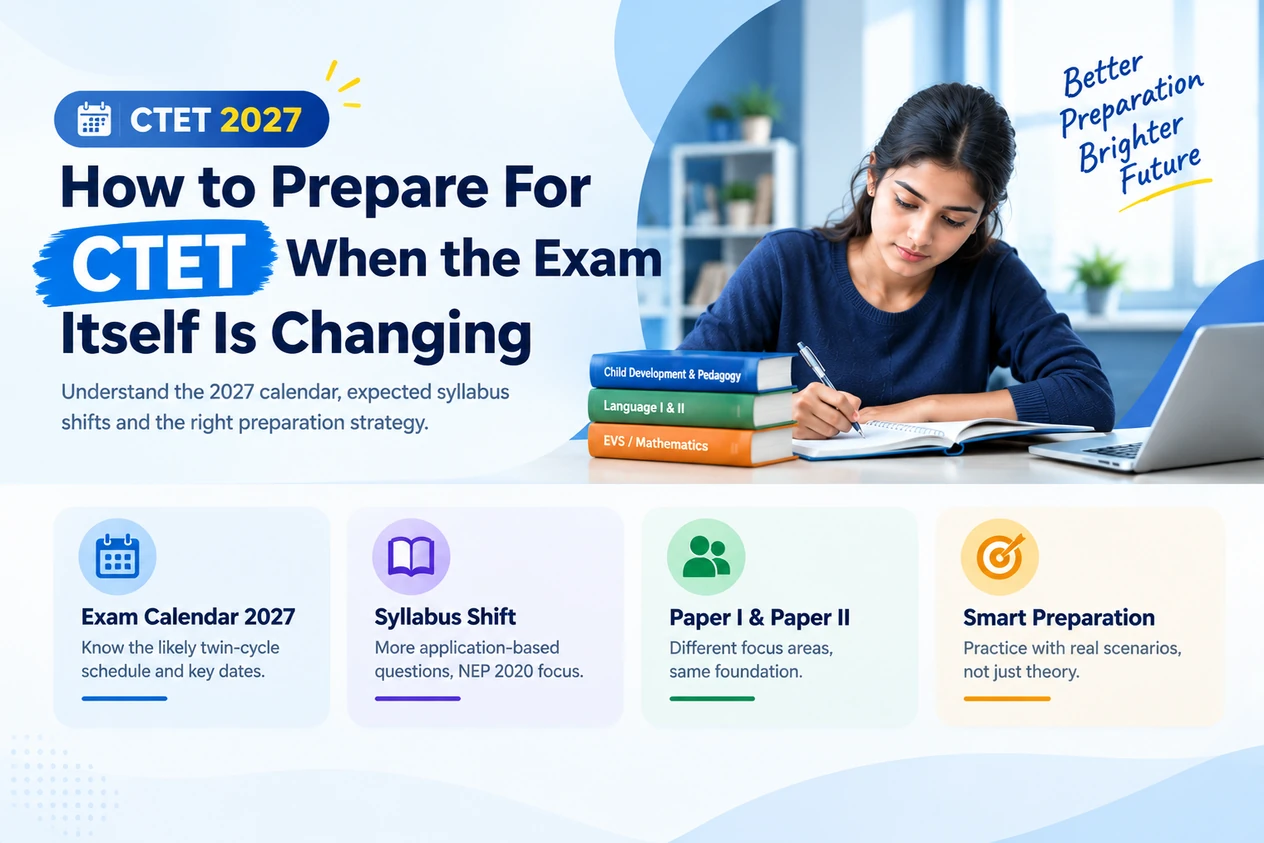
CBSE has run CTET on a fairly dependable rhythm for years now, and there's no real signal that this is about to break. Expect the first 2027 cycle to open for applications sometime around October–November 2026, with the actual test falling in the January–February window. A second cycle typically follows a few months later, usually landing around July.
That two-window structure matters more than it might seem at first glance. It means a candidate who doesn't clear the cut-off in the winter attempt isn't stuck waiting a full year — there's a second shot built into the same calendar year. Exact dates will still come down to CBSE's official notification, so it's worth checking back periodically rather than locking your prep schedule around guesswork. Candidates who've been through the process before have written about top tips to crack the CTET exam in the first attempt, and one theme that keeps coming up is treating the first cycle as the real attempt, not a warm-up.
Here's the part candidates preparing from older material tend to miss. CTET questions have been steadily drifting away from straight definition-recall and toward application-based, scenario-driven items — especially in Child Development and Pedagogy. Instead of asking "What did Piaget call this stage?", papers now describe a classroom situation and ask which response actually fits.
This isn't a random change. It tracks NEP 2020's emphasis on foundational literacy, inclusive classrooms, and understanding how children genuinely learn rather than reciting what a textbook says about learning. Questions built around inclusive education, children with special needs, and multilingual classrooms have also become more frequent. Candidates who spent their prep time memorizing theorist names without ever practicing how to apply those ideas to a real classroom often walk out of the exam hall confused about why a "known" topic felt unfamiliar.
Paper I, aimed at classes 1–5, leans heavily on Child Development and Pedagogy alongside Language I, Language II, Environmental Studies, and Mathematics. The focus stays on foundational-stage learning — how young children pick up language and number sense, and what actually works in an early-learner classroom.
Paper II, for classes 6–8, splits into Mathematics-Science or Social Studies depending on specialization. Pedagogy still carries real weight here, but the subject-content questions demand deeper conceptual clarity than a quick NCERT skim can provide. For candidates appearing for both papers, the smarter sequence is building a shared Child Development and Pedagogy foundation first — since it's common ground between the two — and then branching into subject-specific depth. A structured breakdown of this is covered in this guide comparing CTET Paper I and Paper II preparation approaches, which is worth reading before you commit to a study split.
Given how scenario-heavy recent papers have become, grinding through previous-year MCQs alone won't cut it the way it used to. What actually helps is practice built around classroom situations, teacher-student interaction cases, and inclusive-education dilemmas — the kind of material that mirrors how the exam is now asking questions rather than what it asked five years ago.
This CTET preparation guide on qualifying with confidence and concept clarity walks through how to build that kind of application-first study habit rather than falling back on rote revision. And if you're specifically prepping for the upcoming cycle, this CTET 2026 preparation guide with a smart strategy for the exam ahead lays out a cycle-by-cycle approach that's easy to adapt for 2027 as well.
For candidates who'd rather not navigate this shift alone, a well-organized CTET coaching program in Delhi that has already updated its material to match NEP-aligned, scenario-based patterns saves a lot of wasted effort — you're not left preparing for an exam that no longer exists in its old rote-memorization form. Location matters too, since travel time eats into study hours; candidates based around north and west Delhi often look at CTET coaching in Mukherjee Nagar , while those closer to west Delhi consider CTET coaching in Rajouri Garden or CTET coaching in Uttam Nagar .
Start early, treat both 2027 cycles as genuine opportunities rather than a backup plan, and build your Child Development and Pedagogy prep through application — not just definitions.
You can check our location here: 👉 https://www.google.com/maps?cid=6742692798086226313
OUR COACHING CENTERS IN DELHI
PITAMPURA (HEAD OFFICE)
A: Gate Number 3, Madhuban Chowk, FD-1, 2nd floor Near Madhuban chowk metro station, Pitampura, New Delhi, Delhi 110034
Mobile : 09625657619
 : 09625657619
E : contact@bharatsofttech.com
ROHINI(BRANCH OFFICE)
A : 1st Floor, Pocket D, East Metro Station, 77-78, 12, Sector 8, Rohini, Delhi, 110085
Mobile : 09650 61 3377
: 9650613377
E : contact@bharatsofttech.com
BURARI(BRANCH OFFICE)
A : House no. 3, Rj Computers, land mark, Gali No. 2, near Aggarwal sweets, Block B, Sant Nagar, Burari, Delhi, 110084
Mobile : 09289308217
: 092893 08217
E : contact@bharatsofttech.com
LOCATION
