

Date : 22 July 2026
Delhi Subordinate Services Selection Board (DSSSB) hires for teaching, clerical, technical, and administrative jobs. Familiarity with the structure of the exam, the nature of the distribution of questions, rules for marking, and a method for managing time can lead to improved performance.
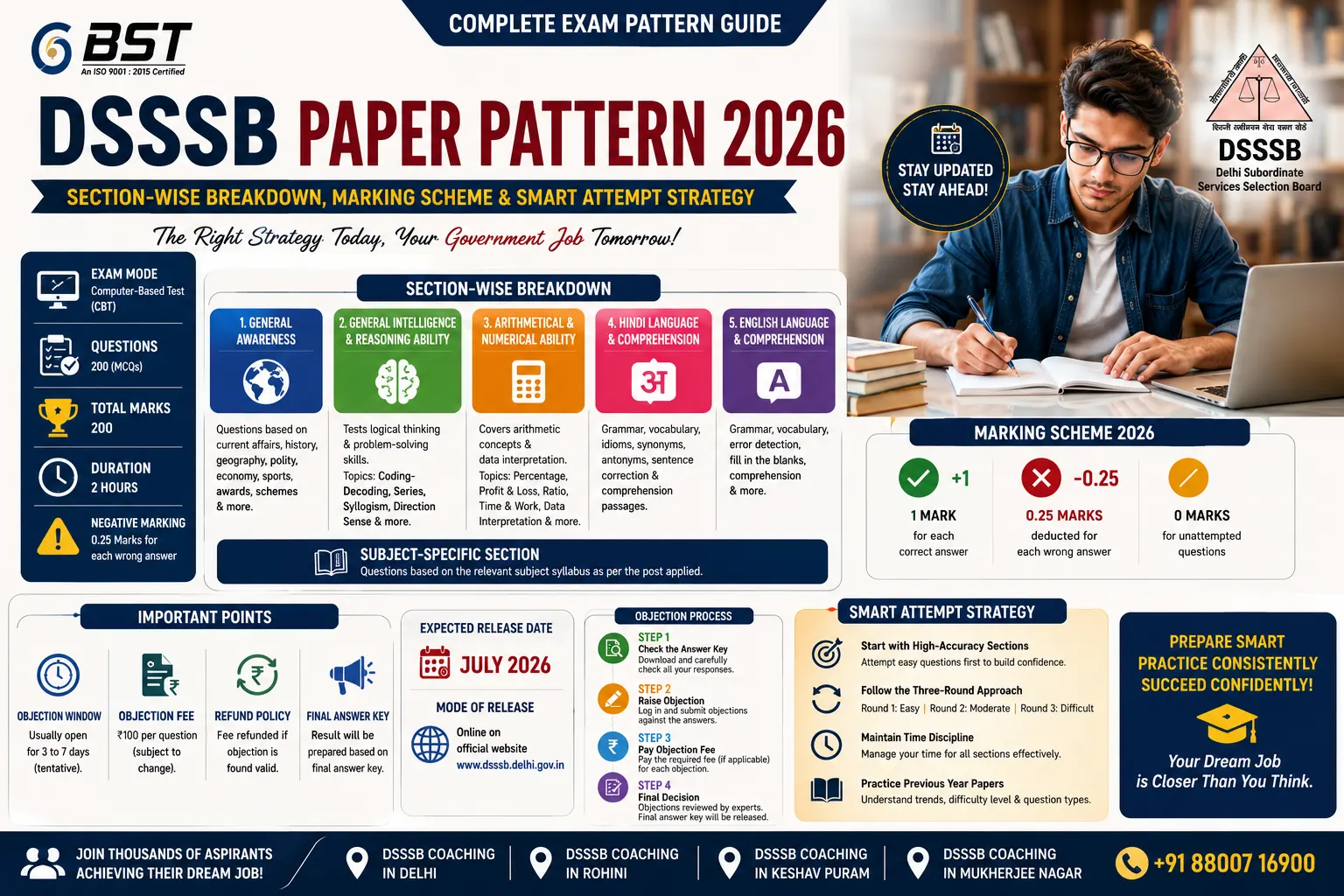
The selection pattern of the DSSSB examination varies with the post and the notification for recruitment. But most DSSSB exams are part of a series of structured Computer-Based Test (CBT) exams that assess the applicants in the categories of General Awareness, Logical Reasoning, Numeric Ability, Language, and Subject Matter.
DSSSB Coaching in Delhi candidates preparing for the exam, the first thing they do is check the latest exam pattern, followed by preparing subject-wise. This guide provides the DSSSB Paper Pattern 2026, section-wise weightage, the DSSSB paper marking scheme, types of questions to expect, and a smart attempt strategy, which is a sure way to approach the exam with confidence.
DSSSB conducts tiered exams according to the requirements of the post. In many posts, recruitment involves a one-tier or two-tier written test followed by skill tests/interviews/document verification where applicable.
MCQ-type questions are the general pattern DSSSB question papers follow. Candidates respond to questions in a computer-based online exam. Each question has several possible answers of which the respondent must choose the best one.
Important points of the DSSSB Exam Pattern 2026 are given below:
• Test type: Computer-Based Test (CBT)
• Sample question: Multiple-choice questions
• Total questions: Usually 200 questions for one-tier exams
• Total marks: Generally 200 marks
• Duration: 2 hours
• Negative marking: Applicable for incorrect answers
The number of sections, the distribution of marks, and the qualifying criteria as per different posts may vary; candidates are advised to refer to the official notification of their post.
Knowing exactly what is in each section can help candidates to allocate preparation time accordingly. Generally, the DSSSB paper consists of five main sections.
The General Awareness part is concerned with the candidate's awareness of current events, history, geography, economics, polity, and significant happenings pertaining to India and the world.
Topics typically include:
• Current events
• History and culture of India
• Indian constitution and administration
• Geography and Economy
• Significant national and international events
• Sports, government schemes and awards
This section contains many direct questions, although candidates require frequent updating as the questions on current affairs can pertain to recent events. It is a good idea to have monthly current affairs notes ready and keep revising important facts. It is also advisable for the candidates to stay in touch with the static general knowledge areas as they are important with regard to other DSSSB exams as well.
The reasoning section takes into account logical thinking, analytical competence, and problem-solving abilities. This is an area where candidates can score highly if they are consistent.
Important topics include:
• Coding-decoding
• Blood relations
• Direction sense
• Series
• Analogy
• Classification
• Syllogism
• Venn diagrams
• Statement and conclusion
• Non-verbal reasoning
In reasoning questions, generally less calculation and more application of logic is needed. Performing a variety of question types regularly is key to improving speed and accuracy.
The numerical ability section tests elementary arithmetic skills and speed of calculation. Candidates should build strong fundamentals, as questions test concepts rather than higher-level math.
Major topics include:
• Percentage
• Profit and loss
• Simple and compound interest
• Ratio and proportion
• Average
• Time and work
• Speed, distance, and time
• Data interpretation
• Number system
There should not be too much time spent on these calculations. Also, practicing previous years' DSSSB question papers and learning shortcuts will help increase speed.
This section tests grammar competence, vocabulary, and reading ability in Hindi. Given that these questions tend to be scoreable, candidates should also be mindful of accuracy.
Common topics include:
• Grammar rules
• Synonyms and antonyms
• Sentence correction
• Idioms and phrases
• Comprehension passages
• Vocabulary-based questions
The English portion tests students' knowledge of English grammar as well as their vocabulary and reading comprehension.
Important areas include:
• Error detection
• Fill in the blanks
• Sentence improvement
• Synonyms and antonyms
• Active and passive voice
• Direct and indirect speech
• Reading comprehension
Candidates should practice grammar rules and solve mock tests to improve their accuracy.
The subject-related section is of high importance in most of the DSSSB posts. Teaching, technical, and other specialized posts generally include questions from the relevant subject syllabus. Candidates need to go through the official syllabus and focus on the concepts. Simply memorizing facts, without making sense of concepts, may be of little use, even for more advanced questions.
Familiarizing yourself with the DSSSB exam marking scheme will help you understand how you should attempt the paper.
The usual marking system is as follows:
| Answer Category | Marks Awarded | Impact on Performance |
|---|---|---|
| Correct Answer | +1.00 Mark | Directly adds to your cumulative score |
| Incorrect Answer | -0.25 Mark | Negative penalty for wrong responses |
| Unattempted Question | 0.00 Marks | No marks awarded, no penalty |
Candidates are advised against blind guessing due to negative marks. Scoring highly has a lot to do with accuracy. Attempting 150 questions with a high level of accuracy, for instance, can yield a superior result than attempting all 200 questions but with a high level of incorrect answers. Before selecting uncertain responses, candidates should estimate their own level of risk.
A planned attempt strategy enhances speed and accuracy. All questions should not be allocated the same time, as some obviously take longer than others.
Write the parts that you feel most comfortable writing first. A lot of candidates like to open with reasoning or language sections, as these sections enable quicker attempts. A self-confidence boost as well as time saved to attempt difficult questions is afforded by first attempting the easier ones.
A three-round method works well during the exam:
Round 1: Answer questions you know on sight. Do not spend more time on hard problems.
Round 2: Tackle the if-you-can-do-the-math questions.
Round 3: Review the doubtful questions and answer only those questions in which you can rule out the wrong options.
Manage your time properly through the two-hour exam. Taking too long on a section can impair performance on the others.
One practical way to do this is:
• Finish easy questions quickly
• Save hard questions for review
• Save the last few minutes for checking marked answers
Previous year papers are very helpful in getting an idea of the trends of questions, the level of difficulty, as well as concepts repeated. They also help candidates understand the actual DSSSB question paper.
Preparation must include concept learning, practice, and revision. Candidates should:
• Refer to the actual syllabus before beginning your preparation
• Set up a section timetable
• Take timed practice tests regularly
• Review every test to analyze errors
• Reinforce major concepts often
• Speed up calculations with daily practice
Regardless if you are doing self-study or you are enrolled in DSSSB Coaching in Delhi or DSSSB Coaching in Rohini, daily revision and following a study plan are important.
The DSSSB 2026 Exam Pattern will assist all the aspirants who are preparing for Delhi government recruitment exams. Familiarity with sectional distribution, scoring patterns, and types and questions for the essay can help aspirants prepare realistically for attempting the exam. DSSSB Coaching in Keshav Puram or DSSSB Coaching in Mukherjee Nagar should also be supplemented by mock tests and previous year papers. The first and foremost step in cracking any DSSSB exam is Conceptual clarity, practice, and Time management. Candidates should be able to use them, in conjunction with regular practice, to improve their chances of getting a competitive score.
OUR COACHING CENTERS IN DELHI
PITAMPURA (HEAD OFFICE)
Metro Pillar No-350, 1st Floor, 15, above Diamond Place Jewellers, Kapil Vihar, Pitampura, New Delhi 110034
Mobile : 09625657619
 : 09625657619
E : contact@bharatsofttech.com
ROHINI
A : 1st Floor, Pocket D, East Metro Station, 77-78, 12, Sector 8, Rohini, Delhi, 110085
Mobile : 09650 61 3377
: 9650613377
E : contact@bharatsofttech.com
BURARI
A : House no. 3, Rj Computers, land mark, Gali No. 2, near Aggarwal sweets, Block B, Sant Nagar, Burari, Delhi, 110084
Mobile : 09289308217
: 092893 08217
E : contact@bharatsofttech.com
LOCATION
