Exam Pattern and Marking Breakdown
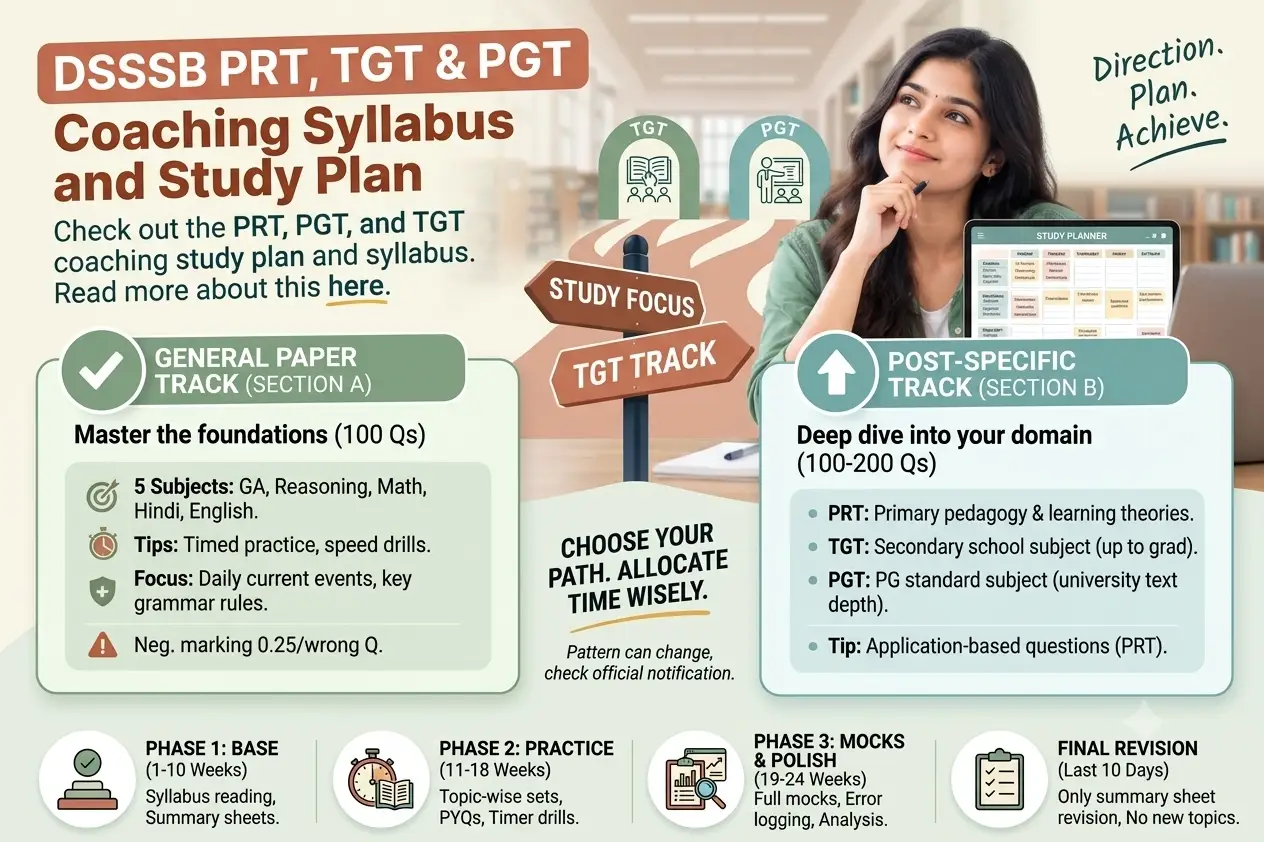
DSSSB teaching papers are computer-based and objective. The examination is generally
bilingual, while the Hindi and English language sections are presented in their respective
languages. Every wrong answer carries a negative marking of 0.25 marks.
Each paper has two parts. Section A is a General Paper worth 100 marks, while
Section B tests what the particular teaching post actually demands.
|
Feature
|
PRT
|
TGT
|
PGT
|
| Section A |
100 Qs / 100 marks |
100 Qs / 100 marks |
100 Qs / 100 marks |
| Section B |
100 Qs: primary-level pedagogy and teaching methodology |
100 Qs: concerned subject |
200 Qs: concerned subject |
| Total |
200 Qs / 200 marks |
200 Qs / 200 marks |
300 Qs / 300 marks |
| Duration |
2 hours |
2 hours |
3 hours |
| Negative Marking |
0.25 per wrong answer |
0.25 per wrong answer |
0.25 per wrong answer |
Important:
Pattern details can change from one advertisement to the next. Always read the current
notice on the DSSSB website before you finalise your preparation plan.
What the Numbers Mean for You
- In PRT and TGT, Section B carries half the paper. In PGT, it carries two-thirds.
- A blind guess has an expected gain of approximately 0.06 marks. If you can eliminate
two options, the expected value increases. Guess only after elimination.
- At 200 questions in 120 minutes, you get roughly 36 seconds per question. Speed is a
skill that needs to be trained.
Subject-Wise Syllabus
Section A: The Five Common Subjects
1. General Awareness
- Current events: national, international and Delhi-specific
- History, Indian polity and the Constitution
- Geography and basic economics
- Sports, art, culture and awards
- General science and everyday technology
- Important institutions and organisations
2. General Intelligence & Reasoning
- Analogies, classification, number and letter series
- Coding-decoding, blood relations and direction sense
- Venn diagrams, syllogisms and statement-conclusion
- Mirror images, paper folding and embedded figures
3. Arithmetical & Numerical Ability
- Number system, percentage, ratio and proportion
- Profit and loss
- Simple and compound interest
- Time and work
- Speed, distance and time
- Mensuration and averages
- Data interpretation
4. Hindi Language & Comprehension
- Vyakaran: sandhi, samas, karak and vachya
- Muhavare and lokoktiyan
- Paryayvachi and vilom shabd
- Shabd shuddhi and vakya shuddhi
- Apathit gadyansh
5. English Language & Comprehension
- Reading comprehension and cloze tests
- Error spotting and sentence improvement
- Para jumbles
- Idioms and phrases
- One-word substitution
- Vocabulary and basic grammar
Section B: Where the Post Decides the Paper
PRT (Primary Teacher)
This section checks whether you can teach children in Classes 1 to 5. Expect questions on:
- Child development and learning theories
- Inclusive education and learners with special needs
- Pedagogy of Hindi, English, Mathematics and EVS
- RTE Act 2009, NEP 2020 and NCF principles
- Assessment, evaluation and classroom management
Aspirants aiming for
DSSSB PRT Coaching in Delhi
should spend most of their energy here because the questions are application-based rather
than purely definition-based.
TGT (Trained Graduate Teacher)
Your concerned subject, such as Mathematics, Science, Social Science, English, Hindi,
Sanskrit and others, is tested up to the graduation level. Questions come from the
secondary-school curriculum and its deeper concepts.
If you are comparing
DSSSB TGT Classes in Delhi
,
check whether the faculty covers your specific subject or only the common Section A papers.
PGT (Post Graduate Teacher)
Section B doubles in size, and the depth rises to postgraduate standard. Candidates who
treat it like a longer TGT paper usually get caught out.
Serious
DSSSB PGT Preparation in Delhi
means going back to standard university-level texts, not just Class 11 and 12 NCERT.
Qualification reminder:
PRT and TGT recruitment may require CTET, while PGT recruitment generally involves
postgraduate-level qualifications and B.Ed. requirements depending on the post.
Always confirm the exact eligibility conditions in the current DSSSB recruitment
advertisement before applying.
The Aspirant Booklist
Fewer books, read more than once, beat a shelf full of unopened guides. Buy the latest
editions and stop collecting after a focused list.
|
Area
|
Recommended Resource
|
Why It Earns a Place
|
| General Awareness |
Lucent's General Knowledge |
Compact coverage of static GK |
| General Awareness |
NCERT History, Polity and Geography Classes 6–12, selected chapters |
Clean, exam-focused facts |
| General Awareness |
Delhi Economic Survey and a monthly current affairs magazine |
Delhi-focused and recent events |
| Reasoning |
A Modern Approach to Verbal & Non-Verbal Reasoning — R.S. Aggarwal |
Wide practice on different patterns |
| Arithmetic |
Fast Track Objective Arithmetic — Rajesh Verma |
Shortcuts plus graded questions |
| Arithmetic |
Quantitative Aptitude — R.S. Aggarwal |
Concept-first base for beginners |
| English |
Objective General English — S.P. Bakshi |
Exam-style grammar and vocabulary drills |
| English |
Wren & Martin |
Rule reference when doubts appear |
| Hindi |
Lucent's Samanya Hindi |
Vyakaran in a quick-revision format |
| PRT Section B |
NCERT Classes 1–5, CTET Child Development & Pedagogy guide, RTE Act 2009 and NCF/NEP summaries |
Content level and pedagogy together |
| TGT Section B |
NCERT Classes 6–12 for your subject plus one graduation-level standard text |
Depth beyond school books |
| PGT Section B |
Standard university texts for your subject plus NCERT Classes 11–12 |
Postgraduate-level accuracy |
| Practice |
DSSSB previous-year papers and a full-length mock test series |
Real difficulty and real pacing |
The Master Study Strategy
Plan for 24 weeks, split into three phases. A full-time aspirant can follow it as
written. If you work, keep the same phases and stretch each one by a few weeks.
Phase 1: Build the Base — Weeks 1–10
Read the official syllabus line by line first and tick off what you already know.
Then work through Section B fully, since it carries the most marks.
Make one-page summary sheets for every chapter. These become valuable during the final
revision period.
Phase 2: Practice Hard — Weeks 11–18
Switch from reading to solving. Do topic-wise question sets, then previous-year papers,
always with a timer.
Track your accuracy per topic, not just your score. A topic at 60% accuracy needs
attention more than one you have not touched.
Phase 3: Mocks and Polish — Weeks 19–24
Take two full-length mocks a week under exam conditions. Spend more time analysing
each mock than attempting it.
Keep the last ten days for revision only. No new books and no new topics.
A Daily Block Plan — Full-Time Aspirant
|
Time Block
|
Focus
|
| 6:30–8:30 AM |
Section B concept study — fresh mind and hardest material |
| 9:00–10:30 AM |
Arithmetic and reasoning, timed practice |
| 11:00 AM–12:00 PM |
General awareness and current affairs |
| 4:00–5:00 PM |
Hindi and English on alternate days |
| 7:00–8:00 PM |
Section B question practice — 40–50 MCQs |
| 9:00–9:30 PM |
Revise the day's summary sheets and plan tomorrow |
Sundays belong to a full mock and its analysis. If you work a job, keep the 6:30 AM block
and the evening practice block, and shift the remaining study sessions to weekends.
How to Analyse a Mock
Keep an error log with three columns:
Knowledge Gap
You didn't know it. Go back to the relevant book or notes.
Silly Mistake
You knew it but misread or mis-clicked. Slow down on the first read.
Time Trap
You knew it, but it consumed too much time. Learn to skip and return.
After four mocks, the error log tells you exactly where your marks are leaking.
Pacing on Exam Day
For the 2-hour PRT and TGT papers, try roughly 40 to 45 minutes on Section A, 60 minutes
on Section B, and keep the remaining time for review.
For PGT's 3-hour paper, give Section B the larger share of your time because it carries
greater weight.
Language questions can often be completed quickly. Clear Hindi and English early so your
slower quantitative and subject questions receive calm and focused time.
Coaching Insights and Local Centers
Coaching cannot study for you. What it can do is remove guesswork: a paced syllabus, a mock
routine that can be difficult to build alone, and someone who catches your errors before
the exam does.
It helps most in three situations: you're new to teaching exams, you cannot stay
consistent alone, or you keep plateauing in mocks.
Questions to Ask Before Joining a Coaching Institute
- Can I attend a demo class before paying?
- Is there a faculty member for my Section B subject?
- How many mocks are included, and is each one analysed with you?
- What is the batch size, and how are doubts handled?
- Do the notes follow the current DSSSB pattern?
Institutes that answer these questions clearly are worth a visit. Travel time also matters.
A centre 90 minutes away quietly eats three hours of your study day, so compare
DSSSB Coaching Centres in Delhi
by distance as well as other factors.
Whichever hub you choose, visit once, sit through a class, and judge it by how well it
teaches rather than how well it advertises.
Start Today, Not After the Notification
The aspirants who clear DSSSB teaching exams rarely have a secret. They start early,
follow a plan, protect their study hours and treat every mock as a lesson.
Open the syllabus tonight and mark what you know and what you don't. Book a demo class
at a centre near you this week, or set up your first mock date if you're studying solo.
If you want
DSSSB Coaching
with a structured plan built around your post, take that first step now.
Frequently Asked Questions
Q1. What is the DSSSB PRT, TGT and PGT exam pattern?
DSSSB teaching examinations generally contain two sections. Section A is the 100-mark
General Paper, while Section B focuses on the concerned teaching post or subject.
PRT and TGT papers are generally 200 marks, while PGT papers are generally 300 marks.
Always verify the latest official advertisement before preparing.
Q2. Is there negative marking in the DSSSB teaching examination?
Yes. DSSSB teaching examinations generally have a negative marking of 0.25 marks for every
incorrect answer. Confirm the marking scheme in the latest recruitment notification.
Q3. What should I study for DSSSB PRT Section B?
PRT Section B focuses on primary-level teaching and pedagogy, including child development,
inclusive education, Hindi, English, Mathematics and EVS pedagogy, RTE Act 2009, NEP 2020,
NCF principles, assessment, evaluation and classroom management.
Q4. What should I study for DSSSB TGT Section B?
TGT Section B focuses on the concerned subject, generally up to graduation level.
Candidates should cover the relevant NCERT Classes 6–12 syllabus and a suitable
graduation-level standard text for their subject.
Q5. What should I study for DSSSB PGT Section B?
PGT Section B has greater weightage and subject depth. Candidates should study standard
university-level texts for their concerned subject along with NCERT Classes 11 and 12
wherever relevant.
Q6. How long should I prepare for DSSSB PRT, TGT or PGT?
A structured 24-week plan can be divided into 10 weeks for building the base, 8 weeks for
intensive practice and 6 weeks for mocks and revision. Working candidates can extend the
same phases over a longer period.


 : 09625657619