


Understanding KVS Interview Process
Securing an interview call from Kendriya Vidyalaya Sangathan is not a walk in the park. It involves a thorough understanding of various parameters. Every year, lakhs of candidates apply and only a select few get an opportunity to sit in the interview.
While giving the interview call is primarily based on the performance of the candidate in the written exam, it also takes into consideration the educational qualifications of the candidate and the cut-off trend of previous years. As such, one needs to work on achieving a high score in the written test, and also work on understanding the educational background of the school management committee.
The final cut-off list is out now.
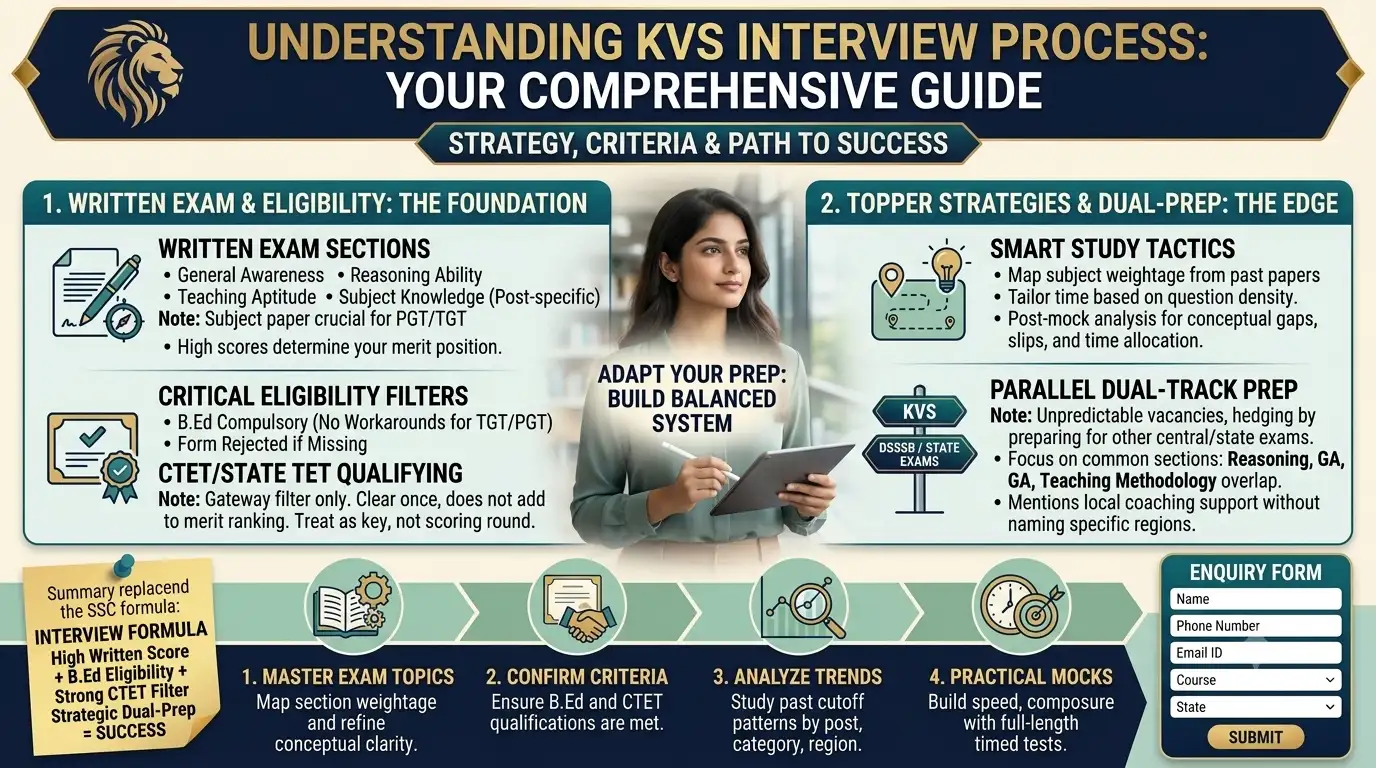
The Written Exam Decides Everything First
Nobody walks into a KVS interview room on the strength of a good resume. You need marks. Specific, competitive marks.
The written test is split across General Awareness, Reasoning Ability, Teaching Aptitude, and a subject-knowledge section tied to your applied post. For PGT and TGT candidates, that subject paper is where most people lose the game. A weak score here, and your overall rank drops out of the safe zone — no matter how strong your teaching experience looks on paper.
Cutoffs move every single year. They shift by category, by post, by region. A general category PRT cutoff for Delhi region can sit noticeably higher than the same post advertised for a smaller zone. That's exactly why guessing your preparation isn't smart. Going through dsssb previous year question papers with answers pdf 2025 and 2026 helps you spot how difficulty levels have shifted over recent cycles — and since general studies and pedagogy sections overlap heavily across central exams, that pattern reading carries over well into KVS prep too.
Educational Criteria Nobody Can Skip
B.Ed is compulsory for TGT and PGT posts. There's no workaround. Miss it, and your form gets rejected regardless of how strong your written score turns out.
CTET, or the equivalent state TET, works as the entry gate. Clear it once, and it opens your eligibility — but here's where people get confused. CTET marks don't add weight to your KVS merit ranking. It functions purely as a qualifying filter. Your actual position on the merit list comes entirely from written exam performance. Treat CTET like a locked door you need a key for, not a scoring round.
What Toppers Actually Do Differently
They don't study everything equally. They study smart.
Start by mapping subject weightage from past papers. A TGT Social Science aspirant, for instance, shouldn't split hours evenly across history, geography, civics, and economics — question density varies year to year, and past trends tell you where to push harder.
Weekly full-length mocks under timed, exam-like conditions build both speed and composure. After each mock, dig into your wrong answers. Was it a concept gap? A silly slip? Poor time allocation? The answer changes what you fix next.
A lot of serious aspirants also lean on DSSSB Coaching in Delhi during this phase, since the syllabus overlap in reasoning, general awareness, and teaching methodology means one structured prep cycle serves two exam goals at once.
Why Candidates Prepare for KVS and State Exams Together
Relying on a single exam is risky. KVS vacancies don't follow a fixed annual calendar, and competition stays intense whenever they do open up. So experienced candidates hedge — they prepare for KVS while keeping a parallel track ready for DSSSB or other state-level teaching exams.
This isn't wasted effort. The core syllabus for TGT-level posts overlaps significantly between KVS and Delhi-based recruitment. Aspirants based near Rohini often join focused DSSSB Coaching in Rohini batches to sharpen exactly the sections that show up in both exams. Similarly, candidates from Uttam Nagar frequently choose DSSSB Coaching in Uttam Nagar so they get local batch timing without sacrificing prep quality.
The same logic holds for the Mangolpuri belt. Local DSSSB Coaching in Mangolpuri centers now run batches specifically designed for candidates juggling both KVS and DSSSB timelines — a practical response to how many aspirants actually prepare this way.
Track Cutoffs Like a Habit, Not a One-Time Check
Don't treat cutoff numbers as something you check once and forget. Follow the trend across years. If MTS-level government posts are also on your radar as a backup option, reviewing something like the DSSSB MTS 2025 Cutoff gives useful context on how competitive government recruitment has gotten across categories recently — even if KVS stays your main target.
Final Word
Achieving the KVS interview stage involves numerous hurdles. You need to clear exams for which the benchmarking scores are kept confidential. Your education and training have to be of high quality and complementary. Simultaneously, you need to develop a well-rounded approach to preparation that increases your chances across several exams rather than staking everything on a single exam. Often, candidates who receive interview calls are the ones who identify and track cutoff trends. They are also the ones who have alternate plans to focus on in case their preparation doesn’t yield the desired results.
FAQs
Q1. Will CTET score be useful in preparing the KVS merit list?
No, CTET/Relevant TETs are qualifying in nature. The written exam decides your final merit.
Q2. Is it mandatory to possess B.Ed for all teaching positions in KVS?
It is mandatory for PGT and TGT. Absence of a B.Ed degree makes your application ineligible, and it is rejected.
Q3. Is it true that KVS cutoffs are fixed?
No, cut offs change with each recruitment. Recent cut offs give an idea about cut offs for current recruitment.
Q4. Should I target KVS only, or should I consider other state teacher recruitments as well?
As preparing for both, that is, targeting KVS and other state teacher recruitments is a better and sensible option. This is because, there is a lot of similarity among the question areas of all these recruitments.
Q5. What do most candidates fail to do while preparing for a teacher recruitment exam?
Most candidates fail to identify the weightage of different areas in the exam. Based on the analysis of previously set question papers, some areas are often neglected by the candidates, resulting in failing to cross the cut off.
 : 09625657619