

Date : 02 Sep 2026
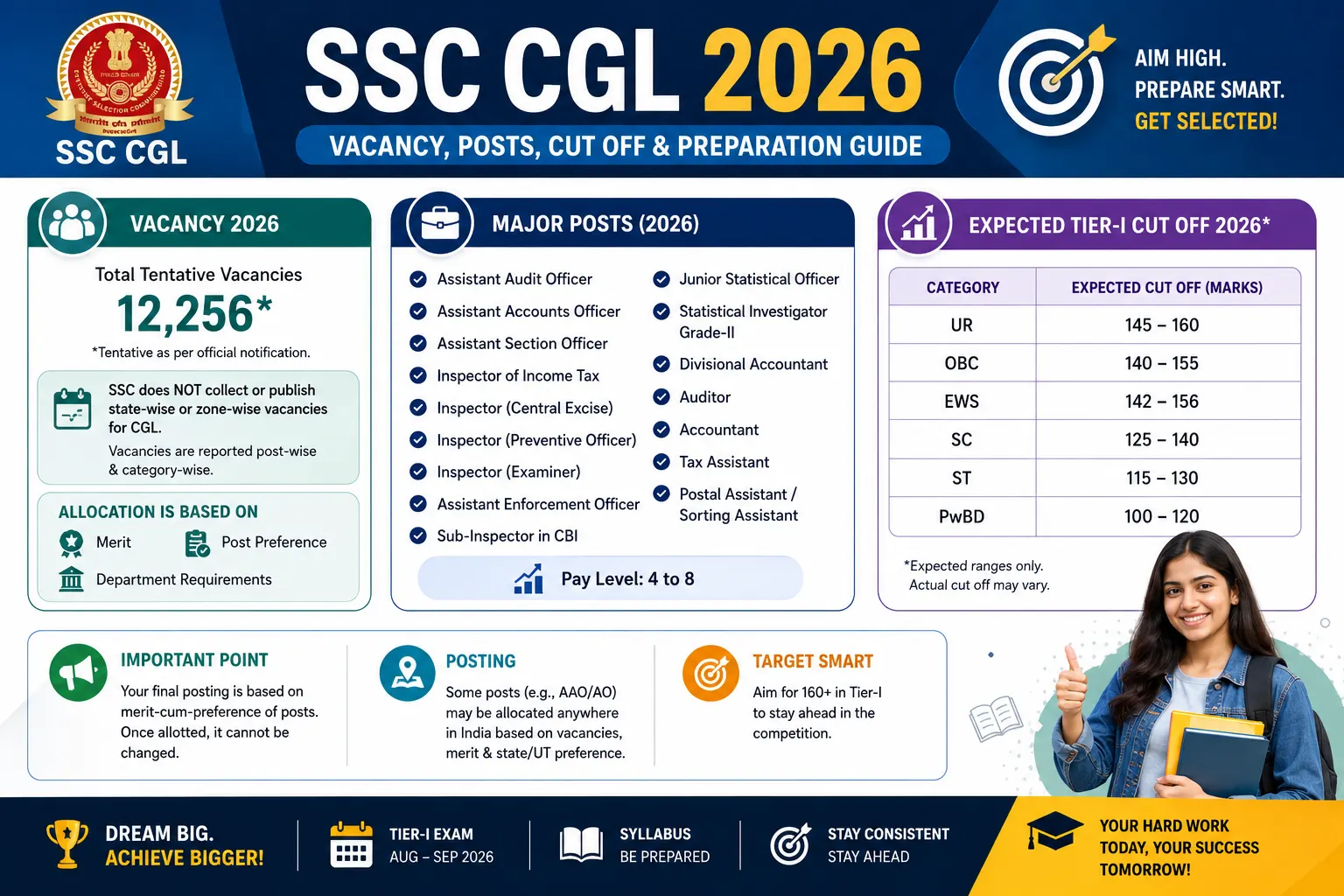
SSC CGL 2026 recruitment has approximately 12,256 tentative vacancies, but candidates often miss an important point: SSC does not collect or publish state-wise or zone-wise vacancies for CGL. Instead, vacancies are reported post-wise and category-wise, while allocation depends on merit, post preferences, department requirements, and, for certain posts, state/UT preferences.
So, if you're searching for the “SSC CGL 2026 state-wise vacancy,” don't rely on unofficial tables claiming that Delhi has X seats, Uttar Pradesh has Y seats, or Maharashtra has Z seats. SSC itself says state-wise/zone-wise vacancy information isn't collected by the Commission.
The official SSC CGL 2026 notification lists approximately 12,256 vacancies. SSC has stated that these are tentative and that updated post-wise and category-wise figures will be published as the vacancy collection process progresses.
The recruitment covers Group B and Group C positions across central government ministries, departments and organisations.
Some of the major posts included in the 2026 notification are:
• Assistant Audit Officer
• Assistant Accounts Officer
• Assistant Section Officer
• Inspector of Income Tax
• Inspector (Central Excise)
• Inspector (Preventive Officer)
• Inspector (Examiner)
• Assistant Enforcement Officer
• Sub-Inspector in CBI
• Inspector Posts
• Junior Statistical Officer
• Statistical Investigator Grade-II
• Divisional Accountant
• Auditor
• Accountant
• Tax Assistant
• Postal Assistant/Sorting Assistant
Note: The notification also shows different pay levels, with posts ranging from Pay Level 4 to Pay Level 8.
No.
This is the most important clarification for candidates planning their preparation around a particular state
SSC's 2026 notification specifically states that state-wise and zone-wise vacancies are not collected by the Commission. Candidates seeking that information are advised to approach the concerned user departments.
That means a table such as the following should not be treated as an official SSC vacancy list:
| State | Claimed Vacancy |
|---|---|
| Delhi | NA |
| Uttar Pradesh | NA |
| Maharashtra | NA |
| Rajasthan | NA |
| Bihar | NA |
| West Bengal | NA |
| Madhya Pradesh | NA |
| Karnataka | NA |
NOTE:There are no official SSC CGL 2026 state-wise figures to fill into this table at present.
This distinction matters because SSC CGL isn't a state government recruitment exam. The vacancies are linked to central government departments and their offices.
Your CGL selection isn't simply a matter of choosing a state and getting a seat there.
SSC's 2026 notification states that final allotment is based on merit-cum-preference of posts. Once a post is allotted, the Commission doesn't change the allocation merely because a candidate later wants another post or location.
For example, suppose two candidates both score well in SSC CGL.
Certain posts have an additional geographical element. For instance, candidates selected for Assistant Audit Officer/Assistant Accounts Officer in the relevant cadre may be allocated to offices across India based on vacancies, merit, and state/UT preference.
That's why post preference is a serious decision, not just an administrative formality.
The SSC CGL 2026 cutoff hasn't been officially released yet. Since the Tier-I examination is scheduled for August-September 2026, the actual cutoff will only be known after the examination and result process.
For preparation purposes, current estimates put the general Tier-I cutoff broadly around the 145-160 mark, depending on category, post, paper difficulty, and overall competition. Some estimates are slightly more conservative, while others put the UR range closer to 155-165.
A practical preparation range would look like this:
| Category | Expected SSC CGL Tier-I Cutoff 2026* |
|---|---|
| UR | 145–160 |
| OBC | 140–155 |
| EWS | 142–156 |
| SC | 125–140 |
| ST | 115–130 |
| PwBD | 100–120 |
*Note: *These are expected ranges, not official SSC cutoffs. The actual cutoff may move significantly depending on exam difficulty, normalization, vacancies, and candidate performance.
There's a big difference between qualifying and being competitive for your preferred post.
For example, if the eventual UR cutoff is around 150 and you score 151, you've technically crossed the expected range. But that doesn't mean you're in a comfortable position for a highly preferred post.
A better target is to build a buffer.
For many serious candidates, aiming for 160+ in Tier-I is more sensible than planning around the minimum expected cutoff.
Previous-year data shows why candidates shouldn't treat one cutoff figure as universal.
In the 2025 cycle, SSC's Tier-I result showed different cutoff levels for different categories. For the relevant general-post list, the revised cutoff figures were around 136.40 for UR, 130.37 for OBC, 127.42 for EWS, 115.03 for SC, and 106.39 for ST.
Other specialised posts can have substantially different cutoffs.
For example, previous-year figures for AAO and JSO were higher than the cutoff for the broader group of other posts.
So when someone says, “SSC CGL cutoff is 150,” ask one more question:
“For which post and category?”
That one question can completely change the answer.
The final cutoff isn't determined by vacancy numbers alone.
A tougher paper can pull the cutoff downward, while an easier paper can push scores upward.
More serious candidates generally mean greater competition for the same number of seats.
The current vacancy figure is approximately 12,256, but SSC has clearly stated that it is tentative and subject to updates.
SSC conducts computer-based examinations in multiple shifts, so marks are normalised before candidates are shortlisted.
Cutoffs can differ according to the post list and candidate category.
This is why an aspirant shouldn't build an entire preparation strategy around a single predicted number.
Generally, there isn't a separate SSC CGL Tier-I cutoff for every state in the way candidates sometimes assume.
The selection process is based on examination performance, category, post preferences, and the applicable vacancy/allocation framework.
State preference can matter for specific cadres or posts, but that doesn't mean a candidate from Delhi has a “Delhi cutoff,” and a candidate from Uttar Pradesh has a separate “UP cutoff.”
The distinction is important.
State-wise vacancies and state-wise cutoff aren't the same thing.
With around 12,256 tentative vacancies, competition is still expected to be intense. The smart approach isn't to predict your exact posting months before selection.
Focus on the score you can control.
If your current mock scores are around 110-120, don't suddenly set 160 as tomorrow's target.
Build it progressively:
• Move from 110 to 125.
• Then target 135.
• Push toward 145.
• Finally, work toward a 155-165+ competitive range.
This gives you measurable progress instead of vague motivation.
Taking 50 mocks without analysing them won't automatically make you better.
After each test, identify:
• Questions you got wrong.
• Questions you guessed incorrectly.
• Questions you left despite knowing the concept.
• Questions that consumed too much time.
• Topics producing repeated mistakes.
Clearing Tier-I is only one stage of the journey.
SSC's 2026 schedule places Tier-II tentatively in December 2026, so candidates shouldn't wait until after Tier-I results to think about the next stage.
If you're serious about SSC CGL, your preparation should gradually include the Tier-II requirements as well.
A structured preparation environment can help when you're struggling with consistency, mock-test analysis, or subject-wise planning.
Candidates looking for SSC Coaching in Delhi can explore classroom-based preparation and guidance designed around competitive SSC exams.
For students specifically searching for SSC Coaching in Mukherjee Nagar, a coaching environment can be useful for maintaining a fixed study routine and getting regular feedback.
If you're comparing institutes for SSC CGL Exam Coaching in Delhi, look beyond promotional claims. Check the faculty experience, test series, doubt support, batch size, study material, and how regularly performance is reviewed.
Students living in the southern parts of the capital can also consider SSC Coaching in South Delhi when choosing a centre that fits their daily commute and study schedule.
The location matters more than many aspirants realise. A two-hour daily commute can quietly consume the time you need for revision and mock analysis.
If you're wondering how to qualify SSC CGL, start with a simple rule: don't prepare for the predicted cutoff; prepare to score comfortably above it.
A candidate targeting 150 because “the cutoff may be 145” is taking an unnecessary risk.
A candidate targeting 165 has room for a difficult shift, calculation mistakes, a few unexpected questions, and normalisation.
That's the difference between cutoff-based preparation and selection-oriented preparation.
• SSC CGL 2026 currently has approximately 12,256 tentative vacancies.
• SSC does not collect or publish state-wise/zone-wise CGL vacancies.
• Updated post-wise and category-wise vacancy figures may be released later.
• There is no single universal SSC CGL cutoff applicable to every post and category.
• Current Tier-I estimates broadly place the UR cutoff around 145-160 marks, but this is not an official figure.
• Candidates should ideally target a score comfortably above the expected cutoff.
• Post preferences can affect final allocation, so they should be filled carefully.
• State preference matters for certain cadres, but SSC CGL shouldn't be treated as a simple state-wise recruitment examination.
• Tier-II preparation should begin well before the Tier-I result.
The biggest mistake would be to spend weeks searching for a state-wise vacancy table that SSC doesn't actually publish.
Use the official vacancy information, track updates from SSC, study the previous cutoff trend, and build your preparation around a high score rather than a minimum score. That's a much safer strategy for SSC CGL 2026.
You can check our location here: 👉 https://www.google.com/maps?cid=6742692798086226313
OUR COACHING CENTERS IN DELHI
Visit Our WebsitePITAMPURA (HEAD OFFICE)
A: Gate Number 3, Madhuban Chowk, FD-1, 2nd floor Near Madhuban chowk metro station, Pitampura, New Delhi, Delhi 110034
Mobile : 09625657619
 : 09625657619
E : contact@bharatsofttech.com
ROHINI(BRANCH OFFICE)
A : 1st Floor, Pocket D, East Metro Station, 77-78, 12, Sector 8, Rohini, Delhi, 110085
Mobile : 09650 61 3377
: 9650613377
E : contact@bharatsofttech.com
BURARI(BRANCH OFFICE)
A : House no. 3, Rj Computers, land mark, Gali No. 2, near Aggarwal sweets, Block B, Sant Nagar, Burari, Delhi, 110084
Mobile : 09650010619
: 092893 08217
E : contact@bharatsofttech.com
LOCATION
