

Date : 14 Sep 2026
DSSSB doesn't run one exam. It runs dozens of them, each tied to a specific post, and the confusion around "the DSSSB pattern" usually comes from treating all of them as identical when they're not. A PRT paper and a PGT paper share a broad framework but differ enough in content weight and subject depth that copying someone else's prep plan rarely works.
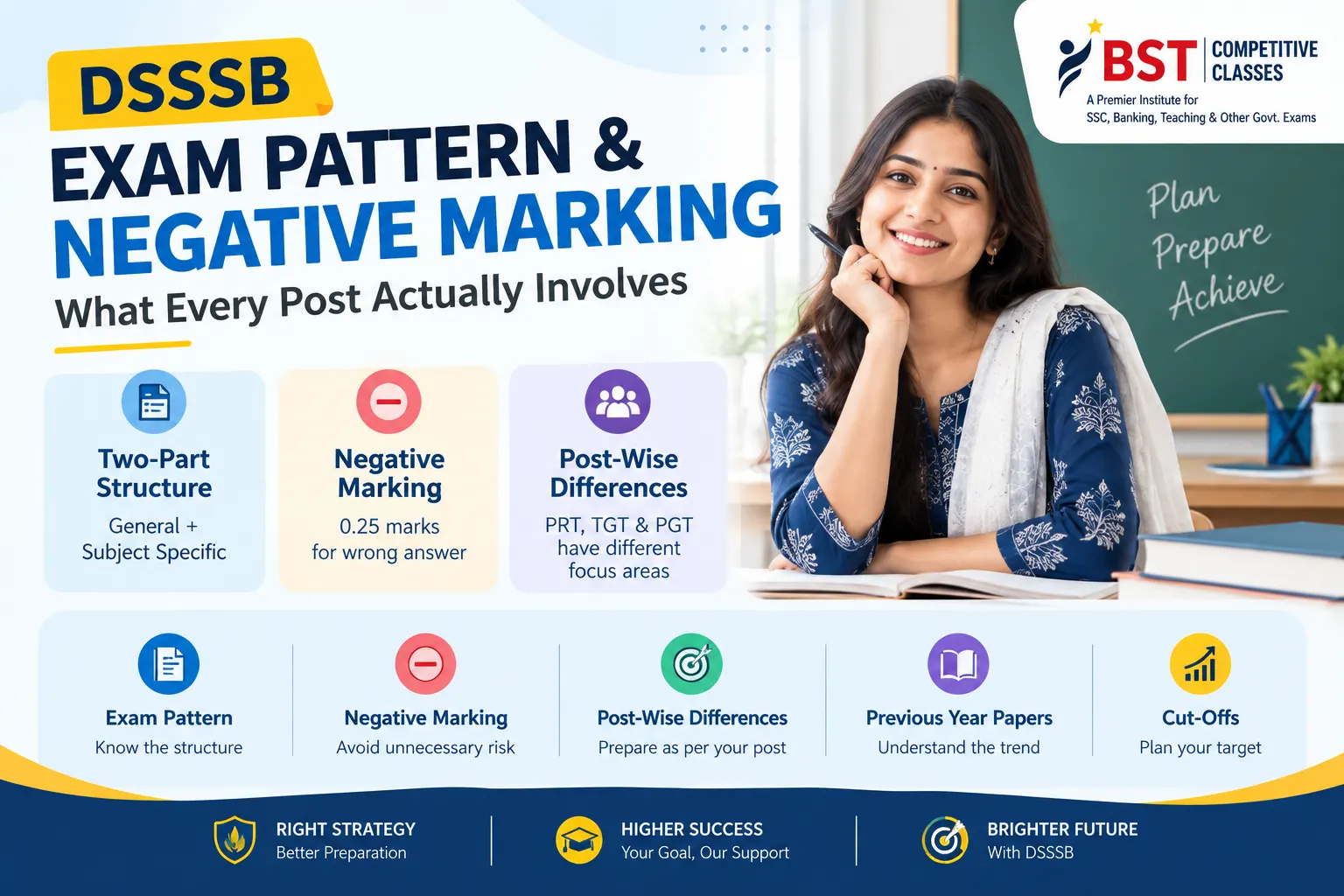
Most DSSSB Tier-I recruitment exams are split into two parts. The first section usually covers General Awareness, Reasoning, Quantitative Aptitude, and General English or Hindi — common ground regardless of the post you're targeting. The second section shifts to subject-specific or post-specific content, which is where the real differentiation happens.
This split isn't identical across every notification, though. Some posts add a third component, some weight sections differently, and the number of questions per section can shift from one recruitment cycle to the next. The safest approach is always to check the specific notification for your post rather than assume last year's pattern carries over exactly. A detailed, post-wise breakdown is available in our DSSSB exam pattern 2026 complete guide, which tracks these variations as they're announced.
DSSSB's CBT format typically applies a 0.25 mark deduction for each incorrect answer. This single rule affects strategy more than most candidates realise. A wrong guess doesn't just cost you the mark you might have gained — it actively pulls your score down, which means unattempted questions are sometimes the smarter choice over shaky guesses.
The practical impact shows up most in Section B, where subject-specific questions can look familiar without actually being straightforward. Candidates who do well tend to have a personal threshold: if they can't eliminate at least two of four options, they leave the question and move on. This isn't caution for its own sake — it's just how the arithmetic of negative marking works out over a 200-question paper.
A PRT candidate is preparing for a primary-level teaching post, which means the subject-specific section leans toward foundational pedagogy and basic subject knowledge. A TGT paper goes deeper into secondary-level subject content. A PGT paper expects postgraduate-level command over the subject, with far less room for surface-level preparation.
This is why generic "DSSSB preparation" advice only goes so far. Someone preparing for DSSSB PRT Coaching in Delhi needs a different subject-depth strategy than someone targeting DSSSB TGT Coaching in Delhi or DSSSB PGT Coaching in Delhi. If you're still deciding which post fits your background and eligibility, our comparison of DSSSB PRT vs TGT vs PGT breaks down the eligibility, pay scale, and subject expectations for each.
Reading about the pattern only gets you so far. Solving actual DSSSB previous year papers shows you how questions are phrased, which topics repeat across cycles, and where the difficulty usually sits within each section. Our DSSSB previous year papers collection is a reasonable starting point if you haven't built a solving routine yet, and pairing it with a subject-wise DSSSB General Awareness model paper helps you gauge where you stand on the common section before moving to post-specific practice.
Cut-off marks for DSSSB exams aren't fixed numbers you can bank on. They shift with vacancy count, applicant pool, and paper difficulty for that particular cycle, so a PGT cut-off from two years ago tells you very little about this year's PRT cut-off. Our DSSSB expected cut-off marks analysis walks through how these numbers are usually estimated and what factors move them.
Candidates who want a structured way to work through all of this — pattern, negative marking discipline, and post-specific subject depth together — often find it easier with guided mock analysis rather than piecing it together alone. A DSSSB Coaching in Delhi program built around your specific post can shorten that process considerably.
Everything you need to know about DSSSB Exam Pattern 2026.
OUR COACHING CENTERS IN DELHI
PITAMPURA (HEAD OFFICE)
A: Gate Number 3, Madhuban Chowk, FD-1, 2nd floor Near Madhuban chowk metro station, Pitampura, New Delhi, Delhi 110034
Mobile : 09625657619
 : 09625657619
E : contact@bharatsofttech.com
ROHINI(BRANCH OFFICE)
A : 1st Floor, Pocket D, East Metro Station, 77-78, 12, Sector 8, Rohini, Delhi, 110085
Mobile : 09650 61 3377
: 9650613377
E : contact@bharatsofttech.com
BURARI(BRANCH OFFICE)
A : House no. 3, Rj Computers, land mark, Gali No. 2, near Aggarwal sweets, Block B, Sant Nagar, Burari, Delhi, 110084
Mobile : 09289308217
: 092893 08217
E : contact@bharatsofttech.com
LOCATION
