

Date : 15 June 2026
Teaching in a government school is one of the most stable and genuinely fulfilling careers a person can build in India. It is not just a job — it is a long-term commitment to public service, to the growth of children, and to the fabric of society itself.
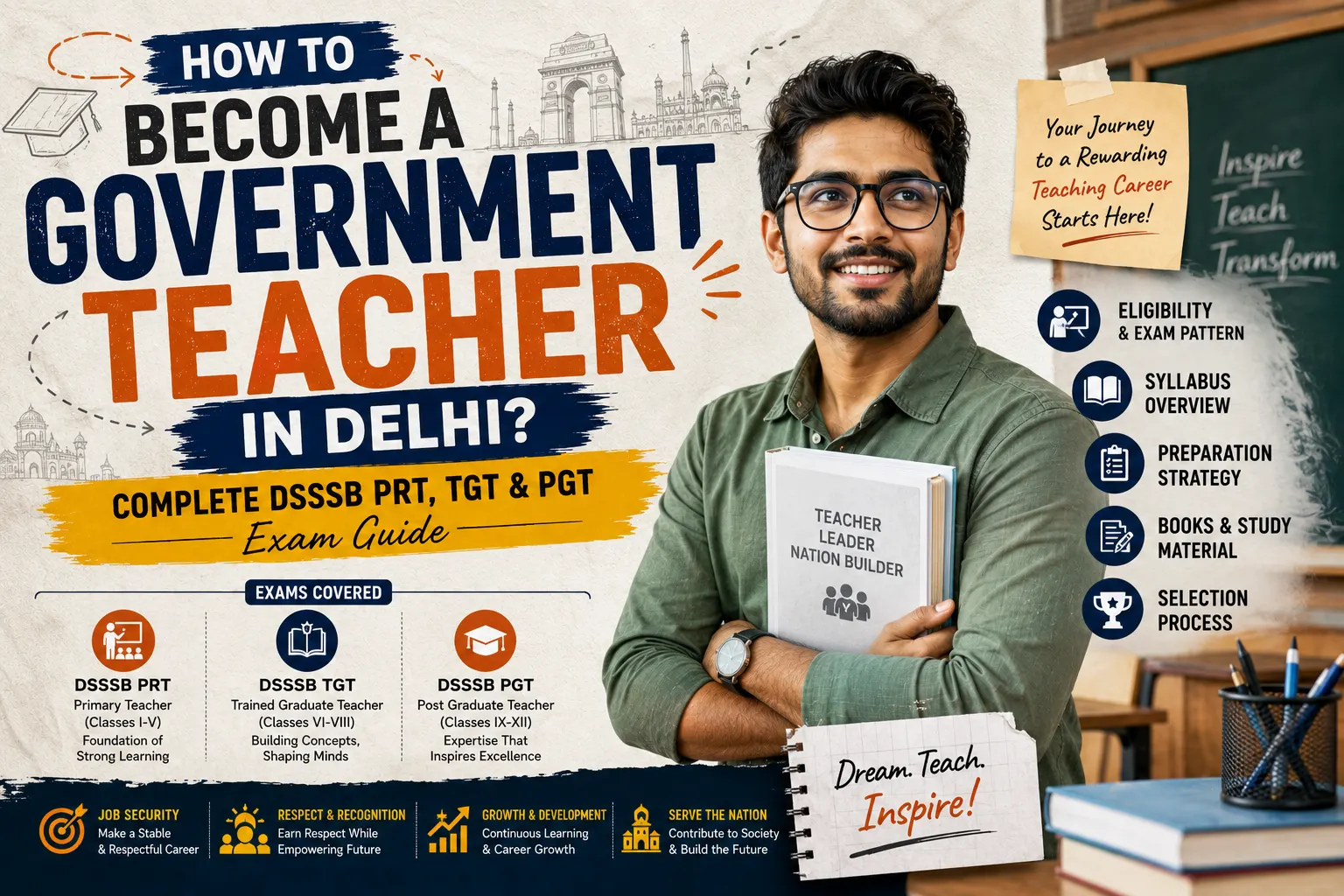
If you are based in Delhi and you want to teach in a government school, the road begins with DSSSB — the Delhi Subordinate Services Selection Board. This is the official recruitment authority under the Government of NCT of Delhi, responsible for selecting teachers at the primary, secondary, and senior secondary levels across all Delhi government schools.
Candidates who start with a clear understanding of what DSSSB expects — and back it up with structured preparation from a credible DSSSB Coaching in Delhi — are the ones who move through the process with focus and confidence rather than confusion.
This guide covers everything you need to know: the three teaching posts, eligibility conditions, how each exam is conducted, the complete syllabus, and a preparation roadmap that actually works.
The Delhi Subordinate Services Selection Board functions under the Delhi government and conducts written examinations for a wide range of government posts. For teaching roles, DSSSB is the single point of recruitment for all Delhi government schools — from Class 1 through Class 12.
DSSSB recruits teachers under three categories:
1. PRT — Primary Teacher (Class 1 to Class 5)
2. TGT — Trained Graduate Teacher (Class 6 to Class 10)
3. PGT — Post Graduate Teacher (Class 11 and Class 12)
Each category has its own academic and professional eligibility requirements, a defined exam pattern, and a specific syllabus. Understanding these differences clearly is the first step in building a preparation plan that is actually aligned with the post you are targeting.
The PRT post is designed for candidates who want to teach at the foundational level — Classes 1 to 5. A primary teacher does not just deliver lessons. At this stage, they are responsible for building a child's relationship with learning itself — nurturing curiosity, encouraging expression, and establishing basic literacy and numeracy in a child's most formative years.
Eligibility Criteria for PRT:
1. Senior Secondary (Class 12) with a minimum of 50% marks from a recognised board
2. 2-year Diploma in Elementary Education (D.El. Ed) from an NCTE-approved institution
3. Must have qualified for the CTET Paper 1 before applying
4. Must have qualified for the CTET Paper 1 before applying
TGT posts are for subject specialists who want to teach Classes 6 to 10. Unlike PRT, a TGT is recruited for a specific subject — Mathematics, Science, English, Hindi, Social Science, Sanskrit, or others. This means your preparation, your exam, and your eventual teaching role are all tied to the subject you choose.
Eligibility Criteria for TGT:
1. Bachelor's degree in the relevant subject with a minimum 50% marks
2. B.Ed (Bachelor of Education) from a university recognised by NCTE
3. Must have qualified CTET Paper 2
4. Age limit: 18 to 32 years, with applicable category-wise relaxations
The PGT post is the most academically demanding of the three. PGTs teach Classes 11 and 12 and are expected to possess expert-level knowledge in their subject, along with the ability to connect that knowledge to the practical needs of students preparing for board exams and competitive entrance tests.
Eligibility Criteria for PGT:
1. Master's degree in the relevant subject with a minimum 50% marks
2. B.Ed from a recognised institution
3. Age limit: 18 to 36 years, with applicable relaxations for reserved categories
4. A CTET qualification is generally not required for PGT posts
If you are still deciding which post to target based on your qualifications and career goals, this comparison on DSSSB PRT vs TGT vs PGT — Which One Is Right for You gives a thorough and honest breakdown worth reading before you commit to a path.
One of the most common oversights among first-time aspirants is treating CTET as an afterthought. It is not. CTET is a mandatory eligibility requirement for both PRT and TGT posts under DSSSB. You cannot apply for these posts without a valid CTET certificate, which makes clearing it your first real milestone on this journey.
Conducted by CBSE, the Central Teacher Eligibility Test assesses a candidate's grasp of child development and pedagogy, language proficiency, and subject-relevant teaching knowledge. CTET Paper 1 qualifies you to teach primary level (Classes 1–5), while Paper 2 qualifies you for upper primary level (Classes 6–10). Once cleared, the certificate holds lifetime validity.
Because CTET and DSSSB share significant syllabus overlap — especially in pedagogy and child development — many candidates prepare for both simultaneously. Enrolling in a structured CTET Coaching in Delhi can help you build this shared foundation efficiently, so your preparation strengthens both exams at the same time rather than treating them as separate efforts.
The DSSSB PRT exam is a One-Tier Written Test carrying 200 marks, to be completed in 2 hours. There is a negative marking of 0.25 marks for every incorrect answer.
| Topic | Marks |
|---|---|
| General Awareness | 20 |
| General Intelligence and Reasoning | 20 |
| Arithmetical and Numerical Ability | 20 |
| Hindi Language and Comprehension | 20 |
| English Language and Comprehension | 20 |
This section is specific to the primary teaching level and covers:
1. Child Development and Pedagogy
2. Primary Mathematics and Environmental Studies (EVS)
3. Hindi and English language skills at the foundational level
4. Teaching-learning methodologies and classroom practices
Equal attention to both parts is non-negotiable. Most candidates who fail do so because they either neglect the general section or underestimate pedagogy. For a structured approach to PRT preparation specifically, this detailed resource on DSSSB PRT 2026 — Key Preparation Strategies for Aspiring Teachers covers exactly what needs to be prioritised at each stage.
Aspirants in North Delhi who want classroom-based guidance for the PRT exam often choose DSSSB PRT Coaching in Pitampura for its focused, exam-pattern-aligned batches.
The DSSSB TGT exam follows the same One-Tier Written Test structure — 200 marks, 2 hours, with 0.25 negative marking per wrong answer.
The structure mirrors the PRT general section: reasoning, numerical ability, general awareness, and language comprehension in both Hindi and English.
This is where the TGT exam diverges significantly from PRT. Part B evaluates:
1. Subject knowledge up to graduation level in your chosen discipline
2. Subject-specific pedagogy and teaching methodology
3. Learning psychology at the secondary stage (adolescent learners)
4. Classroom management, inclusive education, and assessment practices
The depth of subject knowledge required here is considerably higher. A candidate applying for TGT Mathematics, for example, must be thoroughly comfortable with topics from Class 6 all the way through graduation-level mathematics, not just the school curriculum.
For candidates in Delhi looking for expert-led, subject-specific coaching for TGT, DSSSB TGT Coaching in Rohini, Pitampura and Delhi offers well-structured batches with dedicated subject faculty and regular test series.
One area where many TGT aspirants struggle is managing study time across subject knowledge and general sections simultaneously. This article on Time Management Strategies for Cracking DSSSB TGT and PGT Exams provides a practical and tested approach to building a study schedule that does justice to both.
The PGT exam follows the same broad structure as TGT but demands a noticeably higher academic standard throughout. Part B is based on Master 's-level subject knowledge, with a significant emphasis on the candidate's ability to apply that knowledge in a teaching context for Classes 11 and 12.
Part A remains the same general section as PRT and TGT, making it an area where all three categories of aspirants can build common ground during preparation.
For a comprehensive understanding of the PGT exam pattern, marking scheme, and section-wise priorities, this detailed guide on DSSSB PGT Exam Pattern 2026 — Syllabus and Exam Structure is one of the most useful resources available for serious PGT aspirants.
Here is the complete, honest journey from where you are now to the day you walk into a Delhi government school as a selected teacher:
1. Step 1 — Fix Your Target Post: Decide whether you are going for PRT, TGT, or PGT based on your existing academic qualifications and the level at which you genuinely want to teach.
2. Step 2 — Complete Your Teaching Qualification: If not already done, complete D.El.Eligible for PRT or B.Ed for TGT and PGT from an NCTE-recognised institution. This is a prerequisite, not optional.
3. Step 3 — Clear CTET for PRT, clear CTET Paper 1. For TGT, clear CTET Paper 2. This must be done before you apply for DSSSB. Plan your CTET attempt well in advance so it does not delay your DSSSB application.
4. Step 4 — Monitor DSSSB Notifications. Check the official DSSSB website regularly. Do not rely solely on social media or third-party platforms for notification updates. Stay informed through reliable sources. This blog covering DSSSB 2026 Recruitment — PGT, TGT Vacancy, Exam Date and Online Form is a useful reference for tracking current recruitment cycles.
5. Step 5 — Apply Online and Verify Documents. Complete the online application accurately. Cross-check every detail before submission. Keep scanned copies of all required documents ready in advance.
6. Step 6 — Begin and Sustain Structured Preparation. Start your exam preparation the moment you apply. Divide your study time thoughtfully between Part A and Part B. Practise consistently, track your progress, and do not let preparation become passive.
7. Step 7 — Appear for the Written Examination. Take the exam at your allotted centre. Carry all required documents, reach well in advance, and approach the paper with strategy — not panic.
8. Step 8 — Document Verification Shortlisted candidates are called for thorough verification of all original documents, including educational qualifications, teaching certificates, category certificates, and CTET results.
9. Step 9 — Medical Examination A standard medical fitness test is conducted as part of the final selection process.
10. Step 10 — Appointment Letter and Joining. Successful candidates receive a formal appointment letter from the Delhi government and are posted to a government school based on vacancy requirements.
Understanding the syllabus in full — not just in parts — is the single most important thing you can do before you begin preparing.
General Section — Applicable to PRT, TGT, and PGT
1. Indian history, geography, polity, economy, and current affairs
2. Reasoning — analogies, series completion, coding-decoding, syllogisms, direction sense
3. Hindi — grammar rules, comprehension, sentence correction, fill in the blanks
4. English — grammar, vocabulary, reading comprehension, error spotting
Subject Section — PRT
1. Child development theories: Piaget, Vygotsky, Bruner, and Kohlberg
2. Pedagogy for language, mathematics, and EVS
3. Foundational concepts in primary Mathematics and Environmental Studies
4. Inclusive education, learning disabilities, and differentiated instruction
5. Assessment techniques at the primary level
Subject Section — TGT and PGT
1. Subject-specific content up to graduation (TGT) or post-graduation (PGT) level
2. Pedagogical approaches specific to the subject and age group
3. Learning theories applicable to secondary and senior secondary learners
4. Lesson planning, unit planning, and formative assessment strategies
5. Classroom management and educational psychology at the adolescent stage
For the most up-to-date and comprehensive syllabus reference across all three posts, this resource on DSSSB Teaching and Non-Teaching Exam Syllabus 2026 is the clearest and most reliable guide currently available.
The difference between candidates who qualify and those who do not is rarely intelligence — it is almost always consistency, strategy, and honesty about weak areas. Here is what a winning preparation approach genuinely looks like:
1. Start with the syllabus, not random books. Map every topic to the official DSSSB syllabus before you pick up a single study resource. Anything outside the syllabus is time you cannot afford to lose.
2. Use previous year question papers as a compass. Past papers reveal which topics appear most frequently, how questions are framed, and what the difficulty level actually looks like. Begin accessing these early through the DSSSB Previous Year Paper PDF Free Download resource for real exam practice.
3. Give pedagogy the time it deserves. This section is underestimated by the majority of aspirants and consistently separates toppers from those who just miss the cut-off. Cover child development theories, inclusive education, and assessment methods with the same seriousness you give to your subject.
4. Build a current affairs habit. Spend at least 20 minutes daily on reliable news sources. Over six months, this adds up to a substantial advantage in the general awareness section.
5. Take full-length timed mock tests every week. Test-taking is a skill that needs to be built separately from content knowledge. Regular mock tests under exam conditions train your brain to perform accurately within the time limit.
6. Review every mistake — without exception. The revision of wrong answers is where real learning happens. Do not move on from a mock test without understanding why you got each question wrong.
7. Set a realistic score target. Understand what a competitive score looks like for your post and category. This analysis on DSSSB 2026 Expected Cut-Off Marks gives you a data-based benchmark to aim for throughout your preparation.
Candidates in North Delhi who want a competitive study environment with consistent mock testing and experienced faculty guidance regularly opt for DSSSB Coaching in GTB Nagar as their preparation base.
Structured coaching does not replace hard work — it channels it in the right direction. Here is what a good DSSSB coaching institute actually delivers that self-study alone cannot easily replicate:
1. A study plan that maps directly to the current exam pattern and syllabus weightage
2. Subject-wise expert faculty who understand exactly what DSSSB tests and how
3. Weekly mock tests with individual performance analysis and feedback
4. Doubt-clearing sessions that address conceptual gaps before they compound
5. A peer group of serious aspirants that keeps motivation consistent over months
For candidates in West Delhi, DSSSB Coaching in Uttam Nagar brings quality, expert-guided preparation close to home — removing the barrier of long daily commutes while maintaining coaching quality.
Aspirants based near the university corridor in North Delhi often choose DSSSB Coaching in Mukherjee Nagar for the focused, competitive study environment that the area is known for across government exam preparation communities.
For a broader strategic approach that covers all three DSSSB teaching posts, this article on Effective Strategies for DSSSB TGT, PGT and PRT Exam in 2026 outlines a post-wise preparation framework that many successful candidates have used to structure their efforts.
These are the errors that consistently appear among candidates who narrowly miss qualifying — learn them now so you do not repeat them:
1. Preparing without a fixed syllabus reference — leads to wasted effort on irrelevant topics
2. Skipping Part A in favour of subject knowledge — both sections carry equal marks; ignoring either is fatal
3. Leaving pedagogy until the final weeks — it is a conceptually rich section that needs consistent, layered revision
4. Attempting mock tests without post-test analysis — practice without review builds confidence but not competence
5. Ignoring negative marking discipline — random guessing on uncertain questions actively reduces your score
6. Starting preparation too late — six to eight months of serious, consistent study is the realistic minimum for most aspirants
Ans. Yes. CTET Paper 1 is mandatory for PRT, and CTET Paper 2 is mandatory for TGT. CTET is generally not required for PGT posts.
Ans. No. There is no restriction on attempts as long as the candidate continues to meet the age eligibility criteria for the relevant post.
Ans. No. The selection is based entirely on the written exam score, followed by document verification and a routine medical examination. There is no interview round.
Ans. Yes, provided the candidate meets the eligibility criteria for each post individually.
Ans. From the date of notification to the issuance of an appointment letter, the process generally takes between six months and eighteen months, depending on the recruitment cycle and the number of vacancies.
Becoming a government teacher in Delhi through DSSSB is one of the most rewarding career paths available to graduates and postgraduates who want stability, purpose, and the opportunity to genuinely impact young lives.
The process is transparent, merit-based, and well-defined. There are no shortcuts — but there is a very clear path. Know your post, meet your eligibility requirements, clear CTET, prepare honestly and consistently, and approach the exam with both knowledge and strategy.
The classrooms in Delhi's government schools are waiting for ready teachers. If that is the career you are building toward, start today — with a clear head, the right resources, and a commitment that does not waver.
This article is written purely for informational and guidance purposes to assist candidates preparing for DSSSB teaching recruitment examinations in Delhi.
OUR COACHING CENTERS IN DELHI
Visit Our WebsitePITAMPURA (HEAD OFFICE)
A: Gate Number 3, Madhuban Chowk, FD-1, 2nd floor Near Madhuban chowk metro station, Pitampura, New Delhi, Delhi 110034
Mobile : 09625657619
 : 09625657619
E : contact@bharatsofttech.com
ROHINI(BRANCH OFFICE)
A : 1st Floor, Pocket D, East Metro Station, 77-78, 12, Sector 8, Rohini, Delhi, 110085
Mobile : 09650 61 3377
: 9650613377
E : contact@bharatsofttech.com
BURARI(BRANCH OFFICE)
A : House no. 3, Rj Computers, land mark, Gali No. 2, near Aggarwal sweets, Block B, Sant Nagar, Burari, Delhi, 110084
Mobile : 09650010619
: 092893 08217
E : contact@bharatsofttech.com
LOCATION
