

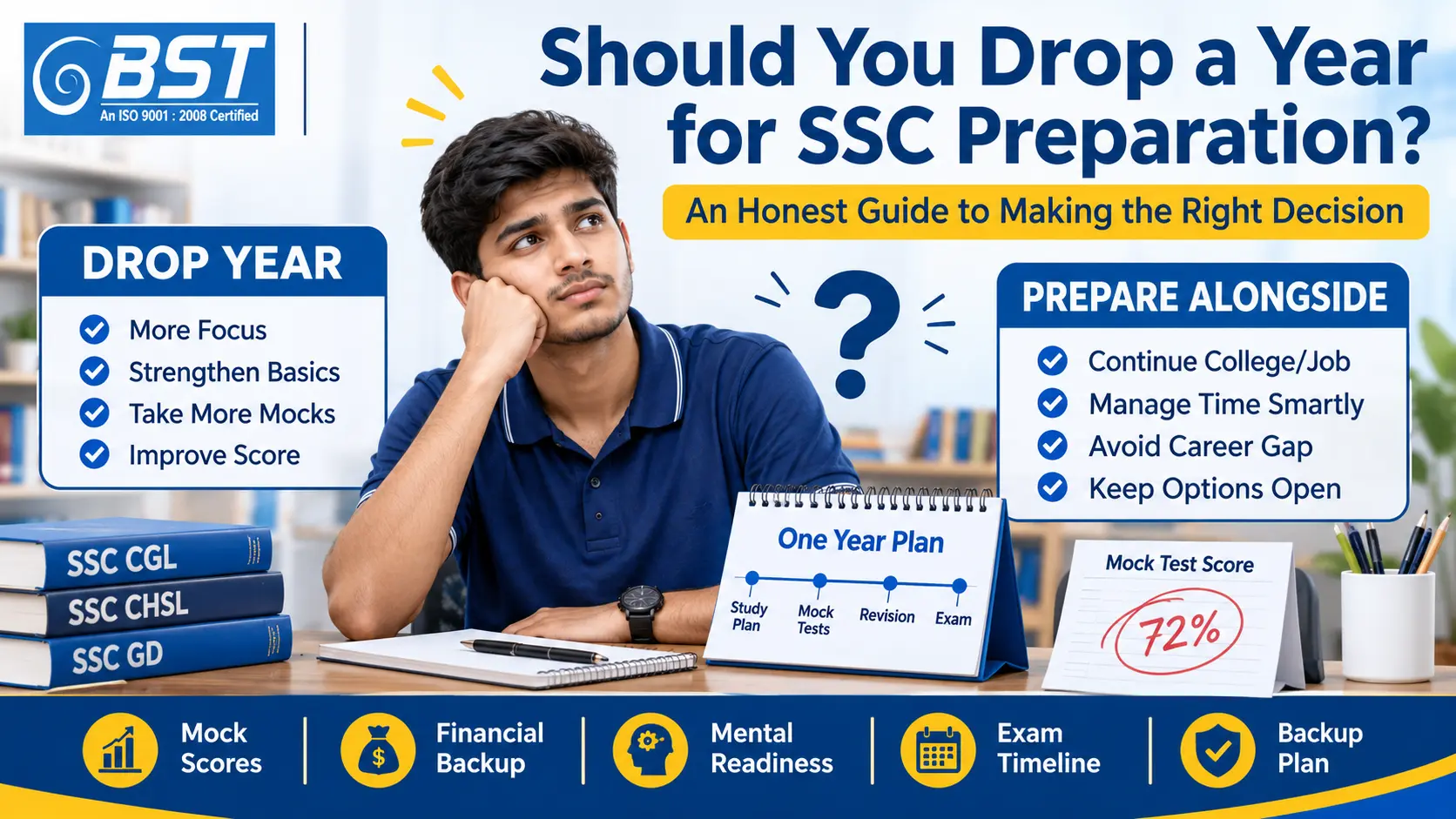
Short answer: Drop a year only if you can prove, with numbers, that one focused year can take you from where you are to a safe cutoff margin. If you can’t, don’t. Prepare alongside college or a job instead.
That’s the honest answer. A drop year is not a magic fix. It gives you time, and time only helps if your starting point, your money, and your mind can support it. The rest of this post shows you how to check all three.
SSC exams are a numbers game. Every cycle, lakhs of candidates apply for posts that run into the thousands. After Tier 1, Tier 2, and document verification, only a small fraction reach a final list. Most toppers did not clear it on their first sitting.
So a drop year doesn’t buy you certainty. It buys you more attempts at better quality.
The emotional side matters too. When you drop, you’re not just “studying full time.” You are telling your family, your friends, and yourself that this year rides on one outcome. That pressure is real. Plan for it instead of pretending it won’t touch you.
If you’re still getting the basics straight, start with the SSC Full Form and the job profiles it leads to. Know exactly what you’re sacrificing a year for.
College lectures, assignments, and part-time work eat 6 to 8 hours a day. A drop year hands those hours back. Most serious aspirants need 7 to 9 focused hours daily to move the needle.
Quant, English, and reasoning reward depth. If your percentages, ratios, algebra, or grammar rules are shaky, you can start from zero and build them properly. Rushed prep patches gaps. A full year closes them.
SSC is a speed exam. You need to solve a question in under a minute, often in 30 seconds. That comes from mock tests, sectional drills, and analysis. A drop year lets you take 80 to 100 full-length mocks instead of 15.
A weak first quarter doesn’t sink you. You have time to fix methods, change strategy, and come back stronger.
Be honest with yourself about these. Most blogs skip them.
Your drop year should be built backward from exam dates. Open the SSC calendar 2026 and mark the notification, application window, Tier 1, and Tier 2 timelines for the exams you’re targeting. Also check the age limit and eligibility for each post.
Then ask: does my year actually overlap with a full cycle? If your drop begins right after a major exam has been held, you may wait months before your next real attempt. In that case, a drop year is far less efficient than it looks.
A central government job offers stability that private roles rarely match: fixed pay scales, allowances, job security, and a pension framework. If you want to see how the numbers may shift, read this breakdown of SSC CGL salary after the 8th Pay Commission before you decide.
This is not a reason to drop blindly. It is a reason to take the decision seriously. A secure career is worth a calculated year. It is not worth a reckless one.
Score yourself honestly on each factor below. Don’t round up.
| Factor | Drop is a good idea if… | Don’t drop if… |
|---|---|---|
| Current mock scores | You score 60 to 70% of the Tier 1 cutoff and your errors are fixable | You score under 40% with weak basics across all sections |
| Time since you started | You’ve prepared seriously for 3+ months and know your weak areas | You’ve only watched videos and haven’t taken mocks |
| Financial backup | You can cover 12 months of expenses without family stress | Your family’s finances can’t absorb a year without income |
| Mental resilience | You stay consistent when alone and recover quickly from low scores | One bad mock ruins your week |
| Fallback plan | You have a graduation degree in progress or a skill to fall back on | You have no plan B |
| Exam timing | Your year overlaps a full cycle with at least 2 to 3 shots | Your next major exam is 14+ months away |
How to read it: Four or more checks in the left column? A drop year is reasonable. Three or fewer? Prepare while studying or working, then reassess in six months.
Your target post should match your education and your current level. Don’t aim above or below without a reason.
| Your qualification | Target exam | Why it fits | Coaching page |
|---|---|---|---|
| Graduates | SSC CGL | The main goal. Structured guidance for the full pattern, including Tier 2 and descriptive papers, makes a real difference. | SSC CGL Coaching in Delhi |
| 12th pass or final-year students | SSC CHSL | Your realistic target and a strong backup to CGL. The syllabus overlaps heavily, so you build skills for both. | SSC CHSL Coaching in Delhi |
| 10th pass or safety-net seekers | SSC MTS | The entry-level option. It’s also useful practice for exam temperament and speed. | SSC MTS Coaching in Delhi |
For a wider look at what formal guidance can and cannot do for you, see this overview of SSC Coaching in India.
Most drop years fail because of poor execution, not poor intent. Here’s a blueprint.
Take two full-length mocks cold. Record your scores by section. This is your starting line, not a verdict.
For every mock, write down each wrong or skipped question. Tag the reason: concept gap, silly error, or time pressure. Review the log weekly. This single habit separates improving candidates from stuck ones.
Monitor accuracy, attempts, and time per section. If your score doesn’t move over 6 weeks, change the method, not just the hours.
Self-study works for some people. Most do better with structure, doubt-solving, and rivals who push them. If you’d rather prepare in person, SSC Coaching in Delhi gives you a disciplined routine and a batch that keeps you honest.
Exercise daily. Talk to one person weekly about how you’re really doing. Limit social media. Set a checkpoint at month six: if your mocks haven’t improved meaningfully, reassess your plan, not your self-worth.
Dropping a year is a bet. Make it with data, not desperation. Score yourself on the matrix, map your year against official dates, and decide your fallback before you start.
If the numbers support you, commit fully and work the plan. If they don’t, you haven’t failed. You’ve saved a year, and you can still prepare seriously on a different track.
Either way, the aspirants who clear SSC are rarely the ones with the most free time. They are the ones with the best system.
It can be, if you study 7 to 9 focused hours daily, take regular mocks, and have solid guidance. Many candidates need two cycles. Plan for that possibility. See our SSC CGL Coaching in Delhi for a structured route.
Usually no. Prepare alongside your degree and drop only if your mock scores show you’re close and your final year allows it.
Have a fallback ready: a related skill, a part-time role, or a backup exam like CHSL or MTS. Document your preparation so the gap is easy to explain.
Yes. Many selected candidates did. It takes discipline and fewer hours, so your timeline is longer, but your financial risk is lower.
OUR COACHING CENTERS IN DELHI
Visit Our WebsitePITAMPURA (HEAD OFFICE)
A: Gate Number 3, Madhuban Chowk, FD-1, 2nd floor Near Madhuban chowk metro station, Pitampura, New Delhi, Delhi 110034
Mobile : 09625657619
 : 09625657619
E : contact@bharatsofttech.com
ROHINI(BRANCH OFFICE)
A : 1st Floor, Pocket D, East Metro Station, 77-78, 12, Sector 8, Rohini, Delhi, 110085
Mobile : 09650 61 3377
: 9650613377
E : contact@bharatsofttech.com
BURARI(BRANCH OFFICE)
A : House no. 3, Rj Computers, land mark, Gali No. 2, near Aggarwal sweets, Block B, Sant Nagar, Burari, Delhi, 110084
Mobile : 09650010619
: 092893 08217
E : contact@bharatsofttech.com
LOCATION
