


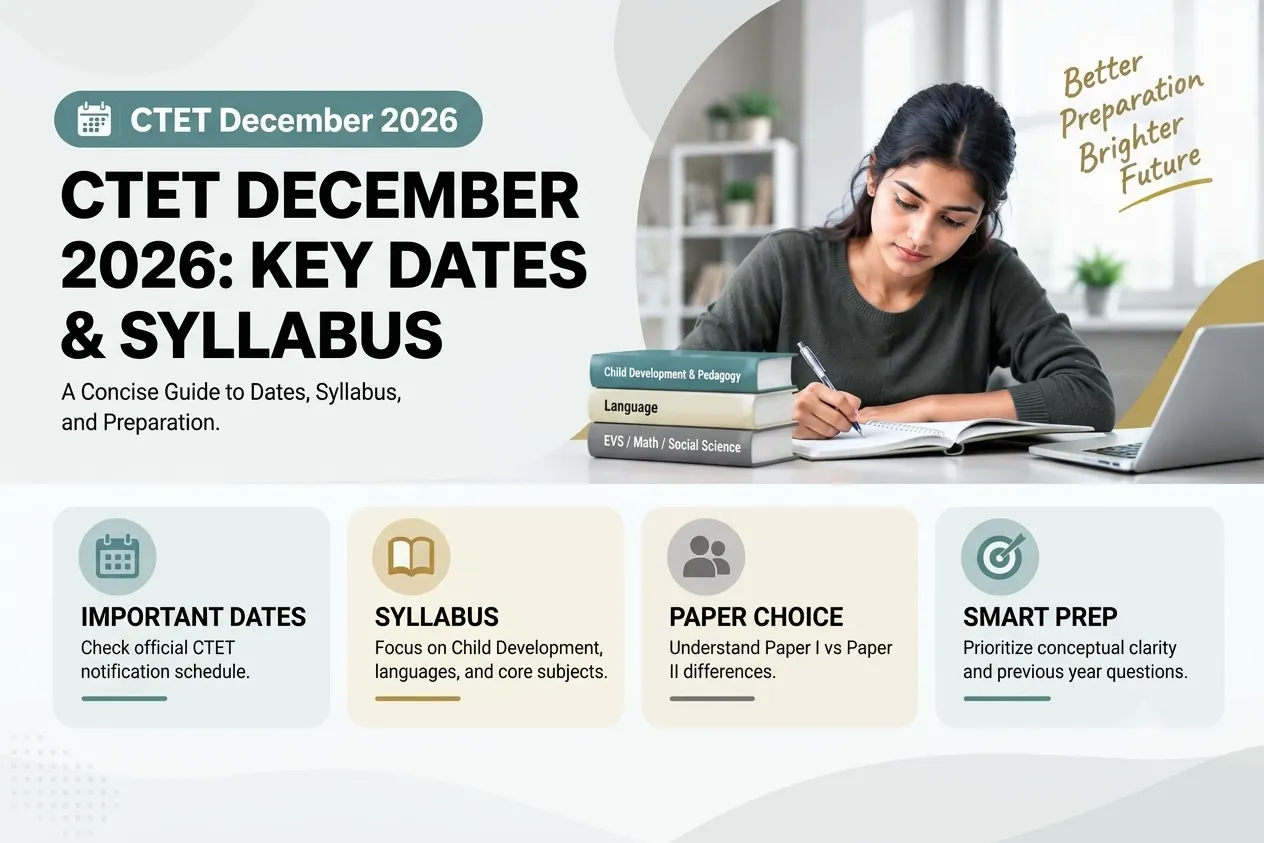
What Is CTET?
The Central Teacher Eligibility Test, commonly known as CTET, is conducted by the Central Board of Secondary Education (CBSE).
The official CTET website explains that the examination is linked to the teacher eligibility requirements for teaching at the elementary level under the relevant framework. Candidates should always check the latest information bulletin for the eligibility requirements applicable to the particular examination cycle.
If you are starting from the basics, the CTET Complete Roadmap: From Eligibility to Qualification and Career Growth can help you understand the broader journey before you begin planning your preparation.
CTET December 2026 Exam Date: What Candidates Should Know
One of the most searched questions is the CTET December 2026 exam date.
However, an expected date should not be presented as an official date. The examination schedule, application period, correction window, city information, admit card and other dates depend on the notification released by CBSE.
Candidates preparing for the December 2026 cycle should therefore regularly check:
- CTET examination notification
- Information bulletin
- Application dates
- Application correction window
- Examination city information
- Admit card
- Answer key
- Result
- Any revised examination notice
The CTET website should remain the primary source for these announcements.
Candidates who are also following changes around upcoming CTET cycles can read CTET 2027 Planning: When the Exam Itself Is Changing. It can be useful when planning beyond a single examination attempt.
CTET Paper 1 or Paper 2: Which Paper Should You Choose?
Before preparing, candidates need to be clear about the paper they intend to take.
The two papers serve different teaching levels, so preparation should be based on the candidate's intended teaching level and eligibility.
A candidate should not select a paper simply because one appears easier. The decision should be connected with the level at which the candidate wants to teach and the eligibility requirements specified in the current CTET information bulletin.
For a detailed comparison, read CTET Paper 1 vs Paper 2: How to Choose the Right One Based on Your Career Goals.
CTET Exam Pattern
Understanding the paper structure before you start preparing prevents a common mistake: spending too much time on one subject while leaving other sections underprepared.
The CTET preparation process should cover the relevant sections of the selected paper rather than focusing exclusively on one subject.
Candidates should check the latest information bulletin for the exact examination structure applicable to their cycle because examination instructions can change.
For candidates who want to understand the structure in greater detail, CTET Exam Pattern 2025 provides an existing BST Competitive Classes resource on the subject. Candidates should use the latest official bulletin alongside older explanatory resources.
CTET Syllabus: What Should You Prepare?
The syllabus should be treated as a working checklist rather than something to read once and forget.
A useful preparation plan breaks the syllabus into smaller areas and then combines:
- Concept building
- Question practice
- Revision
- Error analysis
- Mock practice
Child Development and Pedagogy
Child Development and Pedagogy requires more than memorising definitions. Candidates need to understand how children learn, how individual differences affect learning, and how teaching approaches can be adapted to different classroom situations.
This makes conceptual clarity particularly important.
BST Competitive Classes also has a dedicated resource on Child Development and Pedagogy for CTET: Important Concepts and a Suggested Study Strategy.
Candidates who want to go deeper into classroom behaviour and learning processes can also read:
- How CTET Tests Real Classroom Decision-Making Situations, Triggers, Teacher Responses and Mistake-Handling Skills
- How CTET Evaluates a Teacher's Classroom Psychology, Cognitive Load, Misconception Handling and Learning Behaviours
These resources can complement syllabus-based preparation by helping candidates think about pedagogy through classroom situations.
Language Preparation
Language sections require regular practice. Candidates should work on comprehension, interpretation, and the language-related areas specified for their paper.
Instead of attempting to complete everything in a few days, divide the preparation into manageable sessions and revisit difficult areas during weekly revision.
Mathematics
Mathematics preparation should combine concept understanding with question-solving practice.
Simply reading formulas is not enough. Candidates should identify the types of questions they repeatedly get wrong and maintain a short error list for revision.
Environmental Studies
For Paper 1 candidates, EVS preparation should involve understanding concepts rather than memorising isolated facts.
Connecting textbook concepts with everyday situations can make revision easier and can also help when questions require interpretation rather than direct recall.
Mathematics and Science / Social Studies and Social Science
Paper 2 candidates should divide preparation according to their selected subject area.
The important point is consistency. Trying to complete the entire subject portion immediately before the examination can leave very little time for revision and question practice.
Use Previous-Year Questions as a Preparation Tool
Previous-year questions can show candidates how concepts are tested in an actual examination environment.
They are particularly useful after completing a topic because they allow candidates to check whether they can apply what they have studied.
BST Competitive Classes has a resource covering Practice Paper Tips and Solved Questions from Previous Years for the CTET Exam.
You can also refer to Most Useful Previous Year CTET Questions and Their Answers while building your practice routine.
The objective should not be to memorise old questions. Instead, ask:
- Why was this option correct?
- Why were the other options incorrect?
- Which concept does the question test?
- Did I misunderstand the question?
- Was my mistake conceptual or due to careless reading?
That analysis is often more valuable than simply counting how many questions were attempted.
Why NCERT-Based Preparation Matters
For relevant sections of CTET preparation, candidates should build their concepts from appropriate school-level learning material rather than relying only on coaching notes.
NCERT-based study can help candidates develop the conceptual foundation required for subject preparation.
BST Competitive Classes has also covered this approach in Why Practising NCERT Questions Helps in Preparing CTET.
When using older articles, candidates should still cross-check examination-specific information against the latest official CTET bulletin.
Make Revision Part of the Plan From the Beginning
Revision should not be something left for the final week.
A practical approach is to divide preparation into three stages:
First Stage: Build the Concepts
Understand the syllabus and complete the basic concepts of each section.
Second Stage: Apply the Concepts
Start solving topic-wise questions and previous-year questions.
Third Stage: Revise and Test
Use mock papers, timed practice, and an error notebook to identify areas that still require attention.
Candidates who prefer short revision aids may also find How to Make Flashcards for CTET Preparation useful.
Flashcards are particularly helpful for information that needs repeated revision, but they should support — not replace — conceptual study.
How to Prepare for CTET December 2026 Without Leaving Everything for the End
A long preparation window can become an advantage only when it is used consistently.
Instead of creating an unrealistic timetable, set weekly targets.
For example:
Week 1–2:
Understand the syllabus and identify strong and weak areas.
Week 3–6:
Build subject concepts and start topic-wise practice.
Week 7–10:
Increase question practice and begin timed sections.
After that:
Focus increasingly on revision, mixed practice, and mock tests.
The exact duration can be adjusted according to the candidate's starting level and available study time.
Candidates looking for a broader preparation framework can also read CTET Preparation Guide: How to Qualify With Confidence and Concept Clarity.
For another preparation perspective, see Essential Tips and Resources for Cracking the CTET Exam.
Can You Prepare for CTET Without Coaching?
Yes, preparation methods differ from candidate to candidate.
Some candidates are comfortable studying independently, while others benefit from structured classes, regular testing, doubt support, and a fixed study schedule.
The important question is not whether coaching is universally necessary. It is whether your chosen preparation method is helping you cover the syllabus, practise sufficiently, and correct recurring mistakes.
BST Competitive Classes has specifically discussed this topic in CTET Preparation Without Coaching: Is It Risky?.
CTET Coaching in Delhi: BST Competitive Classes Locations
Candidates who prefer classroom-based preparation can explore the CTET coaching options offered by BST Competitive Classes across Delhi.
The main CTET Coaching in Rohini, Delhi page provides the broader CTET course information.
For an overview of the available centres, visit Our CTET Coaching Centers.
BST Competitive Classes also has CTET location pages covering the following areas:
- CTET Coaching in Uttam Nagar
- CTET Coaching in Shalimar Bagh
- CTET Coaching in Keshav Puram
- CTET Coaching in Rajouri Garden
- CTET Coaching in Tri Nagar
- CTET Coaching in Mukherjee Nagar
- CTET Coaching in Karala
- CTET Coaching in Kanjhawala
- CTET Coaching in Burari
- CTET Coaching in Peeragarhi
Candidates should choose a centre based on factors such as location, class schedule, course structure, and their own preparation requirements rather than choosing solely because a centre is geographically convenient.
More CTET Resources for Your Preparation
CTET preparation involves more than one stage. Candidates may need resources for the examination pattern, preparation strategy, practice, post-examination analysis, and future planning.
The following CTET resources from BST Competitive Classes can be used according to the stage of preparation:
- Prepare for the CTET 2025 – preparation-focused resource.
- Top Tip to Crack CTET Exam in the First Attempt – useful for preparation planning.
- CTET 2025 Exam Date, Admit Card, Syllabus and Pattern – covers the key examination information areas.
- CTET Exam 2025: Mock Interviews, Syllabus, Exam Structure, Dates and Complete Guide – a broader CTET guide.
- After CTET Qualified: What to Do, Scope, Benefits and Jobs – useful after qualification when exploring the next stage.
- CTET 2025 Answer Key and Result Analysis: Expected Cut-Off, Normalization and Next Steps – useful for understanding the post-examination process.
There is also the CTET 2025 Exam Pattern for candidates who want to revisit the examination structure.
Older CTET resources can still provide preparation guidance, but examination dates, application rules, and other cycle-specific details should always be checked against the latest official notification.
What Should You Do After the CTET Examination?
Preparation does not necessarily end when the examination is over.
Candidates should keep track of the official answer key and result process. The official CTET website provides links for results, question papers, and final answer keys.
For candidates who want to understand what can follow after qualifying, the BST Competitive Classes resource After CTET Qualified: What to Do, Scope, Benefits and Job is relevant.
The next step will depend on the candidate's qualifications, eligibility, teaching goals, and the recruitment requirements of the organisation or school.
Common Mistakes Candidates Should Avoid
1. Preparing From an Unverified Exam Date
Do not build your entire preparation around a date circulating on social media or an unofficial website.
2. Ignoring the Latest Information Bulletin
Older CTET articles may contain information from a previous examination cycle. Always verify current examination-specific details.
3. Studying Only One Subject
Strong performance in one area cannot compensate for neglecting the rest of the relevant syllabus.
4. Avoiding Previous-Year Questions
Reading concepts without testing their application can leave gaps unnoticed.
5. Starting Mock Tests Too Late
Timed practice should become part of preparation before the final stage.
6. Memorising Pedagogy Without Understanding It
Pedagogy questions can require candidates to interpret classroom situations. Understanding the principle behind an answer is more useful than memorising isolated statements.
CTET December 2026 Preparation: A Practical Checklist
Before moving into the final stage of preparation, ask yourself:
- Have I confirmed the paper I need to prepare for?
- Have I checked the latest official syllabus?
- Have I divided the syllabus into manageable topics?
- Have I completed the basic concepts?
- Have I solved previous-year questions?
- Have I recorded recurring mistakes?
- Am I revising regularly?
- Have I started timed practice?
- Am I checking official CTET announcements?
- Have I allowed enough time for revision before the examination?
If several answers are still “no”, there is still time to adjust the preparation plan rather than waiting until the final weeks.
Frequently Asked Questions About CTET December 2026
Is the CTET December 2026 exam date officially announced?
Candidates should not treat an unofficial date as confirmed. The examination date should be taken from the official CTET notification released by CBSE.
When should I start preparing for CTET December 2026?
The earlier you start, the more time you have to understand the syllabus, practise questions, and revise. Candidates do not need to wait for the application form to begin studying.
Is CTET Paper 1 different from Paper 2?
Yes. The two papers correspond to different teaching levels and have different subject requirements. Candidates should select the paper according to their intended teaching level and the eligibility conditions in the applicable information bulletin.
Is NCERT useful for CTET preparation?
NCERT material can be useful for building the relevant subject foundation. Candidates should combine conceptual study with CTET-specific question practice.
Are previous-year CTET questions useful?
Yes. They can help candidates understand how concepts are tested and identify areas where additional preparation is required.
Can I prepare for CTET without coaching?
Candidates can use different preparation methods. Self-study may work well for some students, while others may prefer structured coaching, classroom instruction, testing, and doubt support.
Should I rely on old CTET articles for the December 2026 examination?
Older articles can be useful for general preparation guidance, but candidates should not rely on them for current examination dates, application instructions, or other cycle-specific information without checking the latest official CTET notification.
Final Word
Preparing for CTET December 2026 should not begin with trying to predict the examination date. It should begin with understanding the paper, studying the syllabus systematically, and creating enough time for practice and revision.
The most useful preparation plan is one that you can actually follow consistently.
Start with the official syllabus and your chosen paper. Build your concepts, solve questions regularly, analyse your mistakes, and keep revising what you have already studied. At the same time, keep checking the official CTET website so that an official notification does not get replaced by assumptions circulating online.
For candidates preparing in Delhi, BST Competitive Classes provides CTET preparation resources as well as location-specific coaching information. Use the relevant course and location pages according to your preparation needs, and keep examination-specific information aligned with the latest official CTET notification.
 : 09625657619